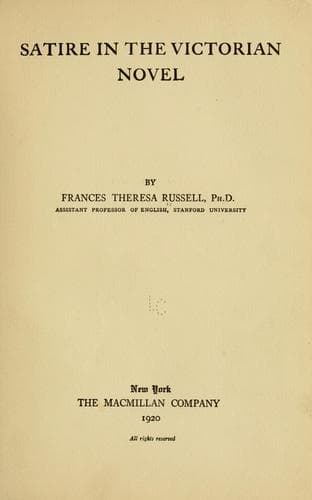
Satire in the Victorian novelRussell, Frances Theresa
History
Satire in the Victorian novel
Russell, Frances Theresa
English fiction -- 19th century -- History and criticism; Satire, English -- History and criticism; Thesis (Ph. D.)
Any final alignment must be left flexible, because of the numerous
factors in the test. Writers may excel in one way or another. When,
however, the same author reappears on every count, it begins to look
suspicious, and the suspicion falls most heavily on Meredith. Others
may come to the top twice or even thrice, but he alone is never wholly
submerged, and is nearly always dominant. When Arnold Bennett declared
that “Between Fielding and Meredith no entirely honest novel was
written by anybody in England,” he was merely following the twentieth
century fad of depreciating the nineteenth,--any smart miss of sixteen
being naturally more modern and sophisticated than her middle-aged
mother. But in saying that “The death of George Meredith removes,
not the last of the Victorian novelists, but the first of the modern
school,” he mentions an obvious fact, not really discredited by the
chronological situation. This does not necessarily argue, be it said,
that Meredith casts the forward shadow of coming events. His strong
individuality did not lend itself to imitation, or even a prompt
appreciation. Moreover, he had in him no germ either of _fin de siècle_
decadence or of its flaunting iconoclasm. In his own mountain range he
is simply a preëminent peak, as in theirs were Chaucer, Shakespeare,
Dryden, Johnson.
As to the lower plateaus and the foothills, the only thing of interest
that develops through examining their juxtaposition, is the resultant
effect on Thackeray. While the others stand firmly up to their own
normal height, making no attempt to add a cubit to their stature,
he seems constantly to be taking thought; nor is it thought that
leads to conclusions of much moment. “His depth,” like Lytton’s, “is
fathomable,” but his air is of the most profound and meditative. It
must be this, together with his _Snobs_ and _Vanity Fair_ (to both
of which, acknowledgments are due) that has bewitched his critics
and persuaded his readers into ranking him as the foremost Victorian
satirist. That he is among the elect is undeniable, even to being “more
long-winded than Horace and bitterer than Juvenal,”[426] but to place
him above them in any absolute way is to ignore the greater range
of Dickens, the keener wit of Peacock and Butler, the rarer charm of
Mrs. Gaskell and Trollope, and above all, the superior penetration and
insight of George Eliot and Meredith.
Public-domain text, read in full here on John Shaqi.
Reviews
Reviews
No reviews yet
Be the first to share your thoughts on this work.
Elsewhere in the archive
Join the Discussion
Join the discussion
Sign in to leave a comment or review.
Sign InorCreate an account