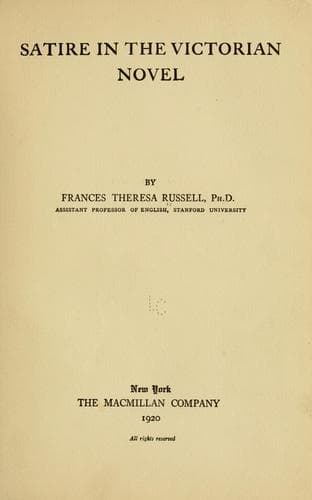
Satire in the Victorian novelRussell, Frances Theresa
History
Satire in the Victorian novel
Russell, Frances Theresa
English fiction -- 19th century -- History and criticism; Satire, English -- History and criticism; Thesis (Ph. D.)
It is not necessary, however, to make all distinctions invidious and
all comparisons odious. Individually and collectively the Victorian
satirists are to be accepted with the ungrudging appreciation they
deserve. The terribly exacting author of _The New Machiavelli_
recognized in their endowment to us nothing but “emasculated thought,”
“a hasty trial experiment, a gigantic experiment of the most slovenly
and wasteful kind,” “a persuasion that whatever is inconvenient or
disagreeable to the English mind could be annihilated by not thinking
about it,”--all resulting in “the clipped and limited literature
that satisfied their souls.” But there is consolation in the
counter-discovery of Professor Sherman (in his _Modern Literature_)
that there was a compensating economy, even in their failure: “Dickens,
Kingsley, Reade, Mrs. Stowe, and the rest,” he reminds us, “they did
not seek to make the world over, but only to accomplish a few, simple
things like abolishing slavery, sweat-shops, Corn Laws, the schools of
Squeers, imprisonment for debt, the red tape of legal procedure, the
belief in pestilence and typhoid as visitations of God--and all that
sort of piddling amelioration.”
For this modest ambition, the Victorians found satire an effective
means, and they proved they could turn it also to more purely artistic
uses. Such as their achievement was, they are doubtless content to
rest in peace upon it, granting without jealousy to their illustrious
successors whatever surpassing results they may be able to accomplish.
CHAPTER II
THE VICTORIAN CONTRIBUTION
By the nineteenth century the general inheritance in ideas and
methods had become so cumulatively rich and various that the chances
for novelty might seem correspondingly meager. But there is always
something new under the sun, and the process of amalgamating that
modicum of newness with the great bulk of the old and established goes
steadily and eternally on--except for abnormal phases of retrogression,
or revolution--forming that ceaseless change in changelessness we call
history. The body of satiric tradition bequeathed to the Victorians
underwent, accordingly, a normal amount of subtraction, addition, and
modification, before being passed on to their successors.
Public-domain text, read in full here on John Shaqi.
Reviews
Reviews
No reviews yet
Be the first to share your thoughts on this work.
Elsewhere in the archive
Join the Discussion
Join the discussion
Sign in to leave a comment or review.
Sign InorCreate an account