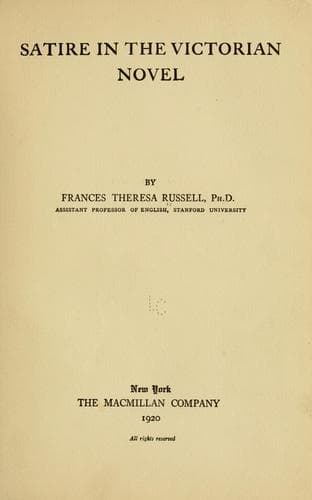
Satire in the Victorian novelRussell, Frances Theresa
History
Satire in the Victorian novel
Russell, Frances Theresa
English fiction -- 19th century -- History and criticism; Satire, English -- History and criticism; Thesis (Ph. D.)
The endowment itself was large and comprehensive, including both
substance and modes, as well as a supplementary current of criticism
and interpretation. In none of these were the Victorians responsible
for a transformation, yet none did they leave _in statu quo_. In
form, however, a great change had recently occurred, operating both
positively and negatively, of which they were just in time to take
advantage. The positive side of it was the development of the satiric
novel in the preceding century, whereby the channel of fiction had
already been accommodated to the satiric stream. This tendency was
reinforced by the negative side, the abandonment of English satire’s
one conventional outlet, the heroic couplet, which naturally diverted
the current still more. The chance that made Byron not only a
brilliant climax to the long line that extended back to Hall and Lodge,
and through them to Juvenal and Horace, but the conclusion as well,
is one of the striking situations in the history of literature. This
transference of the main bulk of satire from the medium of poetry to
that of prose would probably have been accomplished in any case, for
since the Romantic Triumph, poetry had been again devoted to its true
mission as the voice of imagination and spiritual vision, while at
the same time the novel was finding a congenial sphere of action as
a public forum for the discussion of all things from current events
to a philosophy of life. Satire, being presumably a utilitarian
product, would naturally be more suitably allied with fiction, a
branch of Applied Art, than with the Pure Art of poetry. This union is
advantageous for another reason,--the improvement as to proportion.
In verse satire the emphasis is on the satire; in satiric fiction,
the former noun has been relegated to the qualifying function of the
adjective. Since one of the perils of satire is over-emphasis, and
since it can best avoid this peril by combination, the gain in this
arrangement is obvious. As a matter of fact, pure, isolated satire is a
non-existent abstraction, as is illustrated by the very circumstance of
the origin of the name. The _satura lanx_ was a dish of assorted fruit,
and the primitive _saturæ_ which borrowed its name were the impromptu
miscellanies in speech which constituted the social part of the old
Roman Harvest Home. Lucilius and later Horace, wanting a title for
their running commentary on men and manners, found this conveniently
ready. When Juvenal adopted it, he had no notion of restricting the
application:[427]
“_Quicquid agunt homines, votum, timor, ira, voluptas,_
_Gaudia, discursus, nostri est farrago libelli._”
Public-domain text, read in full here on John Shaqi.
Reviews
Reviews
No reviews yet
Be the first to share your thoughts on this work.
Elsewhere in the archive
Join the Discussion
Join the discussion
Sign in to leave a comment or review.
Sign InorCreate an account