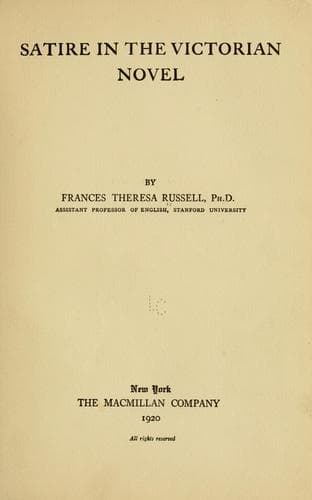
Satire in the Victorian novelRussell, Frances Theresa
History
Satire in the Victorian novel
Russell, Frances Theresa
English fiction -- 19th century -- History and criticism; Satire, English -- History and criticism; Thesis (Ph. D.)
With all these things is the modern novel also concerned, and it too
finds some of them amenable to humorous treatment, and some only to
serious. But so far as change is concerned, it occurs during this
period more in substance than in form. Vice and Folly are still the
nominal targets, whenever these traits seem to be a cause or an effect
of Deceit.[428] But they are somewhat altered in shape, in consequence
of a more subtle analysis of their nature. The great discovery was made
about the deceiver that he is quite as likely as not to be deceiving
himself as well as others,--more than others, indeed, inasmuch as his
very blindness renders him the more transparent. The world, moreover,
growing in suspiciousness and incredulity, is the less easily deceived
and the more able to detect the fraud, which thus reacts like a
boomerang against its perpetrator. In the nineteenth century Pecksniff
really was an archaism; and since Dickens no novelist has portrayed
anything so bald as an unadulterated and unexplained hypocrite.[429]
The evolution in portrayal from the hypocrite to the sentimentalist
is perfectly illustrated by the difference between Pecksniff and
Bulstrode. For the latter we have only a little less sympathy than for
Hawthorne’s Arthur Dimmisdale, in spite of his inferiority in fineness
and ultimate courage. For we are shown the “strange, piteous conflict
in the soul of this unhappy man, who had longed for years to be better
than he was.”[430] Even his prayer after becoming virtually a murderer
is not really a piece of hypocrisy. “Does anyone suppose,” asks Eliot,
“that private prayer is necessarily candid--necessarily goes to the
roots of action?”[431]
George Eliot is, however, even more impressed with the
auto-intoxication of optimism as it manifests itself in what might be
called group psychology; and especially against a disregard of the law
of cause and effect does she turn the shafts of her quiet irony. At the
period when the Raveloe tale opens,--[432]
“It was still that glorious war-time which was felt to be a
peculiar favor of Providence toward the landed interest, and
the fall of prices had not yet come to carry the race of small
squires and yeomen down that road to ruin for which extravagant
habits and bad husbandry were plentifully anointing their
wheels.”
In pursuance of this comfortable philosophy,--
“* * * the rich ate and drank freely, accepting gout and
apoplexy as things that ran mysteriously in respectable
families, and the poor thought that the rich were entirely in
the right of it to lead a jolly life.”
Public-domain text, read in full here on John Shaqi.
Reviews
Reviews
No reviews yet
Be the first to share your thoughts on this work.
Elsewhere in the archive
Join the Discussion
Join the discussion
Sign in to leave a comment or review.
Sign InorCreate an account