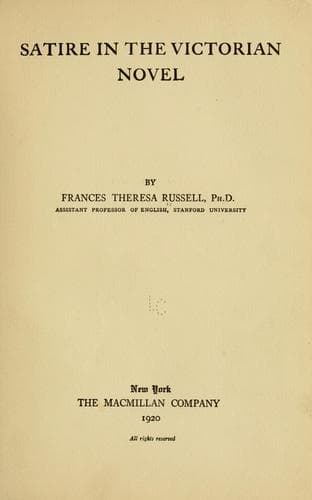
Satire in the Victorian novelRussell, Frances Theresa
History
Satire in the Victorian novel
Russell, Frances Theresa
English fiction -- 19th century -- History and criticism; Satire, English -- History and criticism; Thesis (Ph. D.)
In another story we are introduced to some “pious Dissenting women, who
took life patiently, and thought that salvation depended chiefly on
predestination, and not at all on cleanliness.”[433] In a higher social
class this innocence of the connection between effort and achievement
leads to the fatuous complacency from which Gwendolen Harleth was
aroused by the cruel shock of being told the truth about her musical
abilities:[434]
“She had moved in a society where everything, from low
arithmetic to high art, is of the amateur kind politely supposed
to fall short of perfection only because gentlemen and ladies
are not obliged to do more than they like--otherwise they would
probably give forth abler writings and show themselves more
commanding artists than any the world is at present obliged to
put up with.”
Another busy circle had made two important discoveries: the superiority
of the probable over the actual; and the advantage of a well-chosen
nomenclature, whereby a taste for cruelty may be gratified by the
simple device of calling it kindness. The first was made over the
gossip about Bulstrode:[435]
“Everybody liked better to conjecture how the thing was, than
simply to know it; for conjecture soon became more confident
than knowledge, and had a more liberal allowance for the
incompatible.”
The second developed in a later phase of the same affair:[436]
“To be candid, in Middlemarch phraseology, meant, to use an
early opportunity of letting your friends know that you did not
take a cheerful view of their capacity, their conduct, or their
position; and a robust candour never waited to be asked for its
opinion.”
It was because of this understanding of the limitless possibilities and
universal prevalence of self-deception that Meredith was able to see
the absurdity in egoism, which is the form of the malady induced by
vanity. And this perception, as a modern critic observes, is the source
of the contrast between two well-known egoists,--Sir Charles Grandison
and Sir Willoughby Patterne:[437]
“Both, superficially viewed, are the same type: a male paragon
before whom a bevy of women burn incense. But O the difference!
Grandison is serious to his author, while Meredith, in skinning
Willoughby alive like another Marsyas, is once and for all
making the worship of the ego hateful.”
If one should ask, remembering the necessity for self-assertion in
the exacting requirements of our human destiny, why so indispensable
a thing as egoism should be ridiculous, Meredith has his answer
ready:[438]
“Nay, to be an exalted variety is to come under the calm curious
eye of the comic spirit, and to be probed for what you are.”
It is in “imposing figures” that the malign imps “love to uncover
ridiculousness.” Moreover,--[439]
“They dare not be chuckling while Egoism is valiant, while
sober, while socially valuable, nationally serviceable. They
wait.”
Public-domain text, read in full here on John Shaqi.
Reviews
Reviews
No reviews yet
Be the first to share your thoughts on this work.
Elsewhere in the archive
Join the Discussion
Join the discussion
Sign in to leave a comment or review.
Sign InorCreate an account