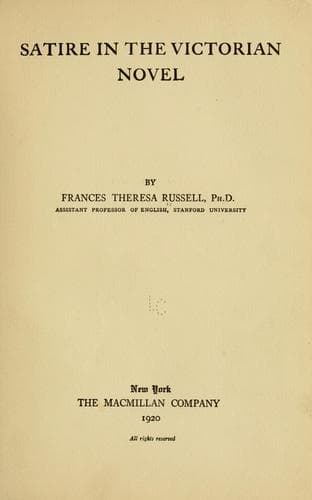
Satire in the Victorian novelRussell, Frances Theresa
History
Satire in the Victorian novel
Russell, Frances Theresa
English fiction -- 19th century -- History and criticism; Satire, English -- History and criticism; Thesis (Ph. D.)
This turn of the satiric road from the hypocritical to the sentimental
side of deceit marked a passage not only through traits of character,
as already noted, but through the realm of institutions, where it might
at first seem to be more out of place. But there is no reason why
organizations should not be as sentimental as the individuals of which
they are composed. Indeed, so far as crowd psychology is in operation,
they would be strengthened in self-deception by their very numbers.
Whether this is the case or not, it is true that the tendency increased
from Peacock to Butler to see in organized groups the absurdity of a
complacent inefficiency. Not because they were failures did English
institutions come under the rod, but because they flourished under a
mighty delusion of success. Smug incompetence, self-satisfied futility,
these were the gaping incongruities between pretense and performance
that made tempting targets out of Society, Church, School, and State;
and thitherward were trained the big and little guns of the satirists.
There is, of course, an underlying cause of this transference of
interest from the more simple and patent hypocrite to the more
subtle and baffling sentimentalist, individual and collective, and
that is found in the spirit of investigation, analysis, probing
beneath surfaces,--not new, to be sure, but newly operative on a
large scale,--known as Science. Science in the intellectual world,
and democracy in the political are the two forces which began in the
nineteenth century the Conquest of Canaan that now in the twentieth
they are gradually completing.
That these two armies are allies is obvious. The end of democracy is an
elevation of the whole plane of human life,--a leveling up and not the
leveling down so feared by Carlyle and the conservative English opinion
of the time. On the emotional and ethical side it is humanitarian,
but in itself it is a rational utilitarian principle. For this
unquestionably practical end, Pure Science furnishes the justification,
indeed, the initial premises, by showing the biology and psychology of
all relationships, the respective effects of coöperation and antagonism
in the natural world, and kindred factors; while Applied Science
supplies the means to that end by discoveries and inventions bearing on
the amelioration and enhancement of living conditions.
The recognition of such startling innovations would be inevitably
slow, and their adoption still slower. But it is precisely in their
ultimately successful struggle for admission into the life and thought
of the nineteenth century that we trace the evolution of the satire
of the period, for the satiric reaction is merely one of the many
reflections of that struggle.
Public-domain text, read in full here on John Shaqi.
Reviews
Reviews
No reviews yet
Be the first to share your thoughts on this work.
Elsewhere in the archive
Join the Discussion
Join the discussion
Sign in to leave a comment or review.
Sign InorCreate an account