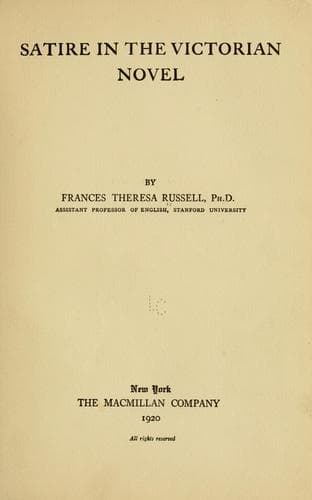
Satire in the Victorian novelRussell, Frances Theresa
History
Satire in the Victorian novel
Russell, Frances Theresa
English fiction -- 19th century -- History and criticism; Satire, English -- History and criticism; Thesis (Ph. D.)
A humanitarian democracy has turned the old _ex cathedra_ criticism
into the forensic. The satirist has been obliged, as one commentator
observes, to descend from the upper window whence he had been
haranguing the mob below; he might have added, much of the mob itself
has been admitted into the entrance halls at least of the great
Administration Building of modern life. But meanwhile the scientific
method has added reason to emotion, so that while the democratic ideal
was conceived in a rationalized sympathy, the stress has slipped more
and more from the sympathetic to the rational element. None of the
Victorians expressly would have denied the Moral Obligation to be
Intelligent, but George Eliot, Meredith, and Butler were the first to
make a real point of it. For by the latter half of the century the
laboratory had come to be acknowledged as the colleague, if not the
successor, of the pulpit, for implicit sermonizing as well as explicit
instruction. And in the exercise of these functions, while the pulpit
may indulge at times in a decorous ridicule, it is the laboratory that
is the real, spontaneous, unconscious satirist. When the solemn moral
exhortation, _Ought_, was supplanted by the autocratic scientific
command, _Must_--_if_, the expression changed from earnest pleading
to detached humor. For the moralist takes himself, his message, and
his hearers, seriously, but the scientist has the indifferent attitude
that if you refuse to obey, the consequences, serious indeed and not
to be averted or escaped, will come, not in the guise of punishment or
retribution, but through the inexorable operation of law. Accordingly,
if you try to delude yourself into the supposition that you can evade
the orders of nature, the joke is on you.
While, therefore, in Victorian satire the old familiar faces of
Society, State, and Church reappear, they are subjected to a new
treatment, as the result of a new diagnosis.
Public-domain text, read in full here on John Shaqi.
Reviews
Reviews
No reviews yet
Be the first to share your thoughts on this work.
Elsewhere in the archive
Join the Discussion
Join the discussion
Sign in to leave a comment or review.
Sign InorCreate an account