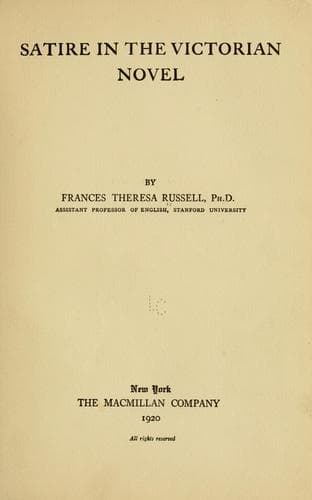
Satire in the Victorian novelRussell, Frances Theresa
History
Satire in the Victorian novel
Russell, Frances Theresa
English fiction -- 19th century -- History and criticism; Satire, English -- History and criticism; Thesis (Ph. D.)
The School and the Press are the only additions to the time-honored
objects, because of their more recent emergence into the light. The
erection of the School into a public institution, together with the
subsidence of the Church into the sphere of private life, marks indeed
a radical change in viewpoint,--advancing from the assumption that the
State must insure the religion of its citizens, let them be educated
how they might (except that for a long time they had no choice but
to take their secular learning from the hands of the clergy) to the
realization that if those responsible for the general welfare would
provide for a general diffusion of enlightenment, the religious
sentiment might safely be trusted to those whom it concerned, namely,
the individuals themselves. In regard to all these institutions the
old, sharply defined contrast between guilty, satirized protagonist
and indicting, satirical antagonist has disappeared. In its place
is a decided tendency toward the fellow-member, fellow-citizen,
fellow-sinner attitude, which at least has the advantage always held
by the empiric knowledge of the insider over the deductive inference of
the outsider.
In the social field the most notable alteration is in the satire
of woman. From the time of the Greek Simonides and the Hebrew
epigrammatists, feminine foibles have been alluring game for
masculine-made arrows. The shrew, the gossip, the blue-stocking, the
interfering stepmother, the intriguing wife, the extravagant daughter,
the lady of fashion, have been detected with unerring clarity of vision
and pursued with accomplished skill. They have also been taken for
granted. It was not until the modern inquiry into cause and effect was
instituted that the feminine failure was viewed as an effect of which
society was largely the cause, by withholding opportunity on one hand,
and on the other encouraging the very ignorance and inanity it affected
to despise. This discovery led logically to the shifting of the satire
from effect back to cause, and the addition of another item to the list
wherein the concerted action of the social group is held accountable
for any malign influence on its members.
Public-domain text, read in full here on John Shaqi.
Reviews
Reviews
No reviews yet
Be the first to share your thoughts on this work.
Elsewhere in the archive
Join the Discussion
Join the discussion
Sign in to leave a comment or review.
Sign InorCreate an account