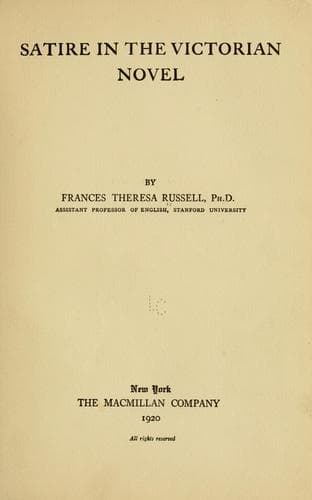
Satire in the Victorian novelRussell, Frances Theresa
History
Satire in the Victorian novel
Russell, Frances Theresa
English fiction -- 19th century -- History and criticism; Satire, English -- History and criticism; Thesis (Ph. D.)
In a national award the satiric prize would undoubtedly go to the
French, whose genius for satire not only gave them preëminence among
the peoples in that line, but gave their satire precedence over their
other literature. But with this exception, the total effect of satire
in the Victorian novel ranks artistically with the highest at large,
and surpasses some other elements of the fiction itself. For the
nineteenth-century novel is undeniably didactic, and therefore, while
it gains in point, significance, and intellectual interest, it loses in
romantic interest and esthetic purity. It is here that satire becomes
its salvation, for by giving much of the criticism a humorous turn it
counteracts the didactic effect, enhances delight, and, to readers
of a sensitive response, makes a point that would not be sharpened
by increased vehemence. No invective against the Countess de Saldar
could be so illuminating as Lady Jocelyn’s thorough relish of her as a
specimen. It is of a piece with Mr. Bennet’s enjoyment of Collins and
Wickham;[457] with Lamb’s avowal that he would rather lose the legacy
Dorrell cheated him out of than “be without the idea of that specious
old rogue;” and with the dismay of Don Antonio over the restored sanity
of Don Quixote.[458] It is the secret of Trollope’s charm, as Hawthorne
indicated when he described the impression of those “beef and ale”
novels,--
“* * * as if some giant had hewn a great lump out of the earth
and put it under a glass case, with all its inhabitants going
about their daily business, and not suspecting that they were
being made a show of.”
It would have been a saving grace to many of the _dramatis
personæ_ if they could have shared the experience of a romantically
inclined youth who, after building an air castle in which he figured
first as a conquering hero and then as a magnanimous patron, suddenly
“came to:”[459]
“And then he turned upon himself with laughter, discovering a
most wholesome power, barely to be suspected in him yet.”
“What a pity it is,” exclaimed Butler,[460] “that Christian never met
Mr. Common-Sense with his daughter, Good-Humour, and her affianced
husband, Mr. Hate-Cant.” Bunyan doubtless would have replied that he
also approved of these somewhat worldly characters, but that they were
people of less importance in their day than they became thereafter. The
progress of the modern pilgrim is toward a City of Sanitation rather
than Holiness, but sanitation is interpreted so widely as to include
the soul also in the cleansing process. For this work Common-Sense and
Hate-Cant are our efficiency experts; and that Good-Humour should be a
member of their household is inevitable at a time when graciousness is
accounted not a negligible adornment but a fundamental virtue.
Public-domain text, read in full here on John Shaqi.
Reviews
Reviews
No reviews yet
Be the first to share your thoughts on this work.
Elsewhere in the archive
Join the Discussion
Join the discussion
Sign in to leave a comment or review.
Sign InorCreate an account