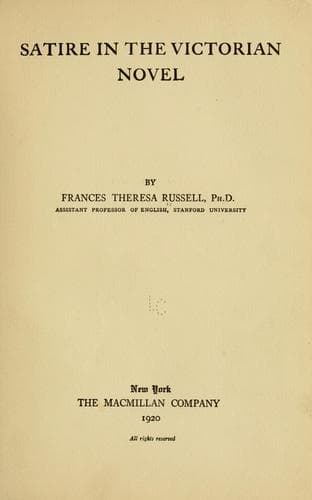
Satire in the Victorian novelRussell, Frances Theresa
History
Satire in the Victorian novel
Russell, Frances Theresa
English fiction -- 19th century -- History and criticism; Satire, English -- History and criticism; Thesis (Ph. D.)
To the poise and proportion contributed to satire by the emphasis on
the quality of humor, must be added the justice that comes from a
rationalized sympathy, and from the counter, positive element which
restores the balance pulled down by destructive criticism. A striking
example of both is furnished by Meredith in his explanation of one of
his characters. No pretender has ever been more skillfully pursued or
more thoroughly unmasked than the ambitious daughter of the great Mel.
After such treatment no one before this time could have presented so
fairly the case for the defendant:[461]
“Now the two Generals--Rose Jocelyn and the Countess de
Saldar--had brought matters to this pass; and from the two
tactical extremes: the former by openness and dash; the latter
by subtlety and her own interpretations of the means extended
to her by Providence. I will not be so bold as to state which
of the two I think right. Good and evil work together in this
world. If the Countess had not woven the tangle, and gained
Evan time, Rose would never have seen his blood,--never have
had her spirit hurried out of all shows and forms and habits
of thought, up to the gates of existence, as it were, where she
took him simply as God created him, and clave to him.”
Thackeray and Trollope also apologize for some of the people they
ridicule, but with this characteristic difference, that Thackeray
bespeaks your indulgence for a Pendennis or a Philip on the Horatian
ground,
“_Nam vitiis nemo sine nascitur; optimus ille est_
_Qui minimis urgetur._”
But Trollope conscientiously reminds the reader that his picture of
an Archdeacon Grantly, a George Bertram, even a Mrs. Proudie, is
one-sided; that their dramatic and amusing faults have been allowed to
overshadow their less entertaining but existent virtues; and that to
know all would be, not to forgive all, but to forgive judiciously. His
story of the childish lapse and manly recovery of the vicar Robarts
concludes with the reflection, “A man may be very imperfect and yet
worth a great deal.”[462] This is a clear, cool discrimination far more
difficult to attain than Thackeray’s nebulous implication that though
this man is certainly very imperfect and not worth a great deal yet his
dear womenkind excuse him and we adore them for it.
George Eliot is too stern to do much excusing, but she always gives
due weight to “the terrible coercion of our deeds.” If she insists on
the baleful effect of yielding to temptation, she insists also on an
appreciation of the tempting force. She analyzes the culprit:[463]
“The action which before commission has been seen with that
blended common-sense and fresh untarnished feeling which is the
healthy eye of the soul, is looked at afterwards with the lens
of apologetic ingenuity, through which all things that men call
beautiful and ugly are seen to be made up of textures very much
alike.”
But at the same time she warns his judges:
Public-domain text, read in full here on John Shaqi.
Reviews
Reviews
No reviews yet
Be the first to share your thoughts on this work.
Elsewhere in the archive
Join the Discussion
Join the discussion
Sign in to leave a comment or review.
Sign InorCreate an account