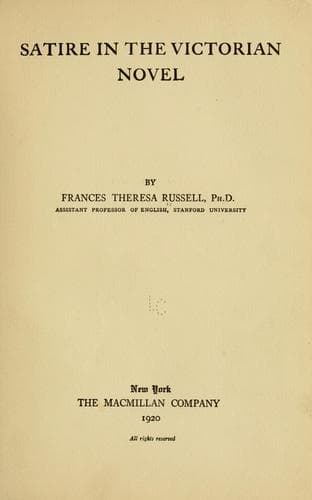
Satire in the Victorian novelRussell, Frances Theresa
History
Satire in the Victorian novel
Russell, Frances Theresa
English fiction -- 19th century -- History and criticism; Satire, English -- History and criticism; Thesis (Ph. D.)
The fear of being ridiculous is of course one of those which may be
punctured to the quick, and thereby a practical change effected. It is
also true that, the human constitution and capacity being what they
are, constant criticism is necessary. It is the spur, the brake,
the corrective, to inform us when we are going too slow, too fast,
or in the wrong direction. It is not by nature an agreeable thing,
and there are times when it should not be made so. But if there are
deeds and characters beyond the reach of humor, it is equally true,
conversely, as Meredith says:[467] “There are questions as well as
persons that only the Comic can fitly touch.” The paradox arises in
the fact that while criticism is essentially scientific, satire is a
branch of esthetics, which nevertheless has practical proclivities.
These it does no harm to exercise, providing it wreaks no violence
on its character as an art. But the effect of satire must not be
confused with its quality. It cannot be said that he satirizes best
who reforms most,--the harvest of reform from satiric seed being
granted. Concerning a pitchfork or muckrake there is no question of
art: concerning a statue there is no question of utility: but satire is
like a silver spoon, which partakes of both qualities, and is estimated
sometimes according to one, sometimes the other, and sometimes a
compromise between the two.
“_C’est une étrange entreprise_,” exclaimed Molière, “_que celle
de faire rire les honnêtes gens_.” The strangeness of it becomes
more striking when we remember that the laughter of the race is
directed against itself and at the very things over which it is most
sensitive,--its own inept follies and poor flimsy pretenses. But it is
unendurable only in the form of the “grinning sneer” of Blifil. Even
ridicule may be welcome if it comes from the genial Allworthy, whose
“smiles at folly were indeed such as we may suppose the angels bestow
on the absurdities of mankind.” Not all satirists are so benign, but
such benignity is not incompatible with the finest satire. Meredith
himself, after writing a dozen novels permeated with the most pungent
satire, said in the last one that “if we bring reason to scan our laugh
at pure humanity, it is we who are in place of the ridiculous, for
doing what reason disavows.”[468]
Public-domain text, read in full here on John Shaqi.
Reviews
Reviews
No reviews yet
Be the first to share your thoughts on this work.
Elsewhere in the archive
Join the Discussion
Join the discussion
Sign in to leave a comment or review.
Sign InorCreate an account