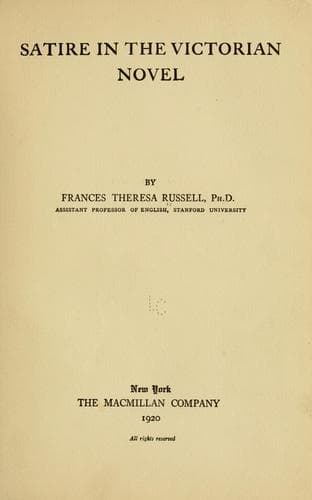
Satire in the Victorian novelRussell, Frances Theresa
History
Satire in the Victorian novel
Russell, Frances Theresa
English fiction -- 19th century -- History and criticism; Satire, English -- History and criticism; Thesis (Ph. D.)
Victorianism has the distinction of being the only period in literature
whose very name savors of the byword and the reproach. To be an
Elizabethan is to be envied for the gift of youthful exuberance and
an exquisite joy in life. To be a Queen Annian (if the phrase may
be adapted) is to be respected for the accomplishments of mature
manhood,--a dignified mein, ripened judgment, and polished wit. To be
a Victorian--that indeed provokes the question whether ’twere better
to be or not to be. The chronological analogy cannot, however, be
carried out, for the Victorian, whatever the cause of his unfortunate
reputation, can hardly be accused of senility. On the contrary, the
impression prevails that the startled ingenuousness, for instance,
with which he opened his eyes at Darwin, Ibsen, and the iconoclasts in
Higher Criticism; the vehemence with which he opposed and refuted and
fulminated against everything hitherto undreampt of in his philosophy;
the complacency with which he viewed himself and his achievements, were
attributes more appropriate to adolescence than to any later time of
life. Withal there was little of the grace and gayety of youth, and
not much more of the poise and humor of manhood. That the Victorian
was never at ease, in Zion or elsewhere, that he was prone to take
himself and his disjointed times very seriously, without achieving
a proportionate reformation, is a charge from which he never can be
acquitted. To our modern authorities, especially such dictators as
Shaw and Wells, contemplating him from the vantage ground of a higher
rung in the ladder of civilization, the Victorian looks as Wordsworth
did to Lady Blandish, like “a very superior donkey,” protected by the
side-blinders of conventionality, saddled and bridled by authority, and
ridden around in a circle by sentiment (most tyrannical of drivers),
with much cracking of whip and raising of dust, but no real change of
intellectual or spiritual locality. Nor can all the cavorting fun of
Dickens, all the pungent playfulness of Thackeray, all the sardonic
gibes of Carlyle, all the grotesque gesturing of Browning, all the
winged irony of George Eliot and Matthew Arnold, not even all the
quips and cranks in _Punch_ itself, avail to quash the indictment. The
Victorian may be defended, appreciated, exonerated even; he may in time
succeed in living it down. But to live it down is not quite the same as
to have had nothing that had to be lived down.
Public-domain text, read in full here on John Shaqi.
Reviews
Reviews
No reviews yet
Be the first to share your thoughts on this work.
Join the Discussion
Join the discussion
Sign in to leave a comment or review.
Sign InorCreate an account