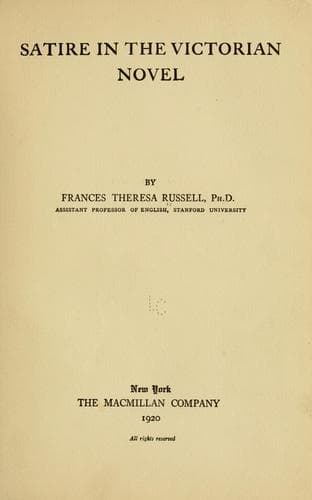
Satire in the Victorian novelRussell, Frances Theresa
History
Satire in the Victorian novel
Russell, Frances Theresa
English fiction -- 19th century -- History and criticism; Satire, English -- History and criticism; Thesis (Ph. D.)
The Novel has been called the Cinderella of Literature. And it is true
that while she may be useful, indispensable, a secret favorite of the
whole family, no magic wand can give her the real enchantment of a
caste that survives the stroke of twelve. She may act as the drudge
to fetch and carry our theories, or the playmate to amuse our idle
hours, but she must be kept in her place, and her place is with neither
the esthetic aristocracy of poetry nor the didactic patricianism of
philosophy and criticism. She has, indeed, recently been fitted with a
golden slipper, but her Prince hails from the Kingdom of Dollars, and
his rank is recorded in Bradstreet instead of the Peerage.
The indifferent or repellent nature of a subject, even though triple
distilled, has nothing to do, however, with its value as a topic
for investigation. I present this study neither as apologist nor
enthusiast. If we expand Browning’s “development of a soul” to include
the mental as well as the spiritual stages, as the poet himself did
in actual practice, we must agree with him that “little else is worth
study.” So persistent and insistent in the mind of man has been, and
still is, the satiric mood, so devoted has he been from immemorial
ages to the habit of story-telling (and seldom for the mere sake of
the story), so voluminous and emphatic did he become in the nineteenth
century, that no complete account of him can be rendered up until, amid
the infinite variety of his aspects, he has been viewed as a Victorian
satirist, using as his medium the English novel.
Whatever the result of this observation may be, the process has been
one of continual delight, tempered by despair; for one enters as it
were a room of tremendous size not only full of curious and challenging
objects (over-furnished perhaps), but supplied also with numerous
doors opening into other apartments, and these ask an amount of time
and attention which only the span of a Methuselah could place at one’s
disposal.
It must be admitted, though, that it is a happier lot to stand before
open doors, even in dismay at the illimitable vistas, than to confront
closed doors or none at all. And I wish in this connection to offer
my tribute of appreciation and admiration to one who has prëeminently
the scholar’s talisman of Open Sesame into the many and rich realms
of literature. It was my good fortune to prepare this study under the
direction of Professor Ashley H. Thorndike, of Columbia University,
by whose benignly severe criticism so many students have profited, by
whose sure taste and searching wisdom so many have been guided. To
him, to his colleagues in the English Department, and to the other
officers of the University who helped to make my term of residence the
satisfaction it has been, it is a pleasure to express my gratitude. To
my Stanford colleague, Miss Elisabeth Lee Buckingham, I am indebted for
the drudgery of copy-reading, both in manuscript and in proof, and for
many valuable suggestions.
Public-domain text, read in full here on John Shaqi.
Reviews
Reviews
No reviews yet
Be the first to share your thoughts on this work.
Join the Discussion
Join the discussion
Sign in to leave a comment or review.
Sign InorCreate an account