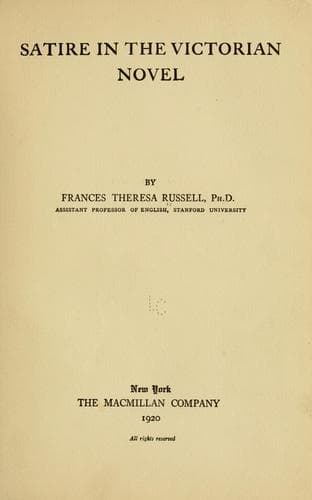
Satire in the Victorian novelRussell, Frances Theresa
History
Satire in the Victorian novel
Russell, Frances Theresa
English fiction -- 19th century -- History and criticism; Satire, English -- History and criticism; Thesis (Ph. D.)
“Men’s future upon earth does not attract it; their honesty
and shapeliness in the present does; and whenever they wax out
of proportion, overblown, affected, pretentious, bombastical,
hypocritical, pedantic, fantastically delicate; whenever it
sees them self-deceived or hoodwinked, given to run riot in
idolatries, drifting into vanities, congregating in absurdities,
planning short-sightedly, plotting dementedly; whenever they are
at variance with their professions, * * * whenever they offend
sound reason, fair justice; are false in humility or mined with
conceit, * * * they are detected and ridiculed.”
Meredith[47] also reiterates the distinction made by Swift and Fielding
in regard to misfortune:
“Poverty, says the satirist, has nothing harder in itself than
that it makes men ridiculous. But poverty is never ridiculous to
Comic perception until it attempts to make its rags conceal its
bareness in a forlorn attempt at decency, or foolishly to rival
ostentation.”
And he remarks of Molière:
“He strips Folly to the skin, displays the imposture of the
creature, and is content to offer her better clothing.”
Of the two forms of affectation, Fielding chooses hypocrisy as better
satirical game, but Bergson[48] votes for the other:
“In this respect it might be said that the specific remedy for
vanity is laughter, and that the one failing that is essentially
laughable is vanity.”
Fuess[49] makes for the last great poetic satirist the familiar
conventional claim:
“Byron is attacking not virtue, but false sentiment, false
idealism, and false faith. His satiric spirit is engaged in * *
* tearing down what is sham and pretence and fraud.”
Previté-Orton[50] applies the test to politics:
“Finally, there is another service political satires render,
which is peculiarly necessary to a government based on
discussion. One of the greatest evils in such a state is
the presence of mere words and phrases, and of the vague
Pecksniffian virtues. Now to satire cant and humbug are
proper game. It brings fine professions down to fact, points
the contrast between the commonplace reality and its tinsel
dress, and by the dread of ridicule raises the standard of
plain-dealing. Other means of criticism as well act as a check
on more opprobrious faults in public life. But satire is the
best agent to keep us free from taking words for substance.”
Apparently, then, we may conclude that deception in some form is, so
far as any one thing can be, the basic object of satire, or at least is
so considered by those who reflect upon it. But we must admit here as
elsewhere that to recognise a phenomenon is easier than to account for
it.
Public-domain text, read in full here on John Shaqi.
Reviews
Reviews
No reviews yet
Be the first to share your thoughts on this work.
Join the Discussion
Join the discussion
Sign in to leave a comment or review.
Sign InorCreate an account