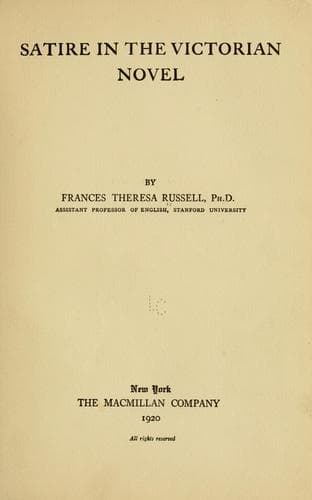
Satire in the Victorian novelRussell, Frances Theresa
History
Satire in the Victorian novel
Russell, Frances Theresa
English fiction -- 19th century -- History and criticism; Satire, English -- History and criticism; Thesis (Ph. D.)
Not that it is difficult to account for the deception itself. No
instinct is more fundamental and irresistible than that of concealment.
The primary fear of molestation or harm in which it originates becomes,
in a social state of sophistication and artifice, fear of exposure.
With increased development, such complex and opposing factors as pride
and shame, avarice and generosity, ostentation and modesty, lead us
to hide things. We hide all sorts of things, good and bad; faults,
virtues, deficiencies, accomplishments, hoardings, and charities. We
hide from ourselves as well as from others. The left hand is as a rule
not on terms of confiding intimacy with the right, whether it is
scattering seeds of kindness or getting into mischief. In the mental
realm the same trick of camouflage prevails. Out of spiritual cowardice
we conceal from ourselves the disturbing facts of life, and purchase
optimism at the easy price of sentimentalism.
But just why this ubiquitous habit should be the peculiar province of
the satirist, is another psychological problem; and as such, is best
reached through a psychological solution. Why is there about deception
something inherently repugnant and at the same time automatically
amusing? Why is our incorrigible human predilection for belonging
to the Great Order of Shams equalled only by our incorrigible human
predilection for joyous exposure of others? The game seems to be mutual
and perpetual, and the honors about even.
The repugnance undoubtedly comes less from a noble devotion to truth
than from the dislike we all have of being deceived. Nothing do we
discover with more exasperation, and admit with more reluctance than
the fact that we have been fooled or hoodwinked. It is an experience
that fosters present irritation and future distrust; but one which,
from its very nature, demands the retort ironic rather than the lofty
indignation accorded to an open injury. Most emphatically “We all hate
fustian and affectation,” and any knavish trickery, especially in
others.
The amusement arises from the triumph of frustrating this attempt at
deceptive concealment, intensified by the pleasure in perceiving an
incongruity--in this case, between the assumed and the actual--which
is the essence of humor.[51] The zest lies in the endless sport of
hide and seek, veiling and unveiling, blowing bubbles and pricking
them, which is exhilarating through the play of wits and the fun of
outwitting.[52]
This would perhaps be a sufficient account were it not for a certain
left-handed yet inseparable connection of the psychology of the
question with its ethics. Whether or not an intruder, the latter has
entered in and firmly entrenched herself. When therefore she maintains
that her satiric discontent is divine, she must be given a respectful
hearing; though after it we seem unable to concede more than the
possibility.
Public-domain text, read in full here on John Shaqi.
Reviews
Reviews
No reviews yet
Be the first to share your thoughts on this work.
Join the Discussion
Join the discussion
Sign in to leave a comment or review.
Sign InorCreate an account