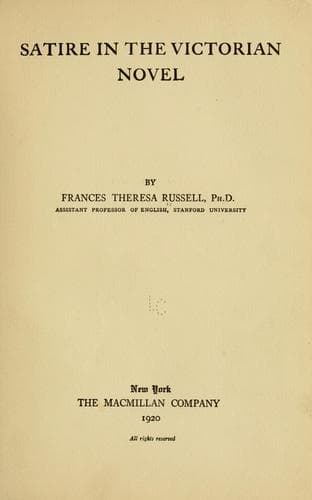
Satire in the Victorian novelRussell, Frances Theresa
History
Satire in the Victorian novel
Russell, Frances Theresa
English fiction -- 19th century -- History and criticism; Satire, English -- History and criticism; Thesis (Ph. D.)
The modern author has conquered these requirements and obstacles, not
by taking arms against his sea of troubles, but by the less intrepid
and more diplomatic method of disowning his title. The satirist is
obsolete, but the satiric writer, or even better, the writer with a
satiric touch, is more in evidence than ever. It is perhaps too much
of a challenge to say that Shakespeare is a greater satirist than
Aristophanes, Jonson, or Molière; but no one would deny the superior
quality of his smaller amount. The aroma of his delicate spice and
lemon extract has not only lasted longer than their pepper and vinegar,
but is better relished by the modern palate. The nineteenth century
had no Shakespeare to “stoop from the height of a serene intelligence
to sport with satire,” but its best satire came from those who took it
least seriously and insinuated it with least pomp and circumstance. And
so far from being the most conspicuous in the satiric field, these who
are greatest in this matter are also greatest and best known for other
than satiric gifts and accomplishments.
While these humorous critics would be more content than their
forerunners with the early dictum that satire was “invented for the
purging of our minds,”[69] rather than for the practical consequences
sometimes claimed for it, yet they would not adopt the succeeding
phrase of the definition,--“in which human vices, ignorance and errors,
* * * are severely reprehended;” for they would qualify more carefully
the objects, and abstain from severity in their reprehension.
This dividing line among objects would make, however, a scientific
rather than an ethical bisection. The “stolidly conscientious
performance” of confining the practice of satire to a moral issue,
does indeed, as Dr. Alden points out,[70] argue a “deficiency in wit”
that marks the Anglo-Saxon mind. But as the Englishman became more
cosmopolitan, he learned to disguise such of his innate solemnity
as he could not shed. That he has absorbed more completely the more
easily assimilated Hebrew and Roman traits, has not prevented him from
acquiring some also from the Greek and the French. The Victorian is
naturally a multiplex compound, and in him we see all these elements in
various stages of conflict and combination.
CHAPTER II
THE CONFLUENCE
Our present study is concerned with the union of two ancient streams of
literature as they come together on the fertile plain of the nineteenth
century. This marriage of a satiric Medway and a fictional Thames is
a happy English event, though by no means the first alliance between
these historic families. In their long careers they are found sometimes
entirely separate, but very often united. The latter course works for
a decided mutual advantage, with a preponderance of gain accruing to
satire, as fiction can live without satire far better than satire
without fiction.
Public-domain text, read in full here on John Shaqi.
Reviews
Reviews
No reviews yet
Be the first to share your thoughts on this work.
Join the Discussion
Join the discussion
Sign in to leave a comment or review.
Sign InorCreate an account