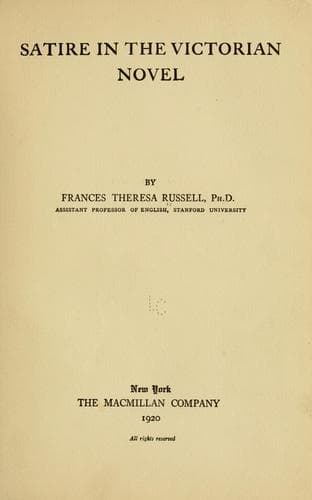
Satire in the Victorian novelRussell, Frances Theresa
History
Satire in the Victorian novel
Russell, Frances Theresa
English fiction -- 19th century -- History and criticism; Satire, English -- History and criticism; Thesis (Ph. D.)
“Yet spiteless in a sort, considered well,
Since I pursued my warfare till each wound
Went through the mere man, reached the principle
Worth purging from Athenai. Lamachos?
No, I attacked war’s representative;
Kleon? No, flattery of the populace;
Sokrates? No, but that pernicious seed
Of sophists whereby hopeful youth is taught
To jabber argument, chop logic, pore
On sun and moon, and worship Whirligig.”
But while the good satirist must have these assets, it does not follow
that the possession of them will guarantee good satire. It can only
be said that without them he cannot be ranked high, though, having
them, he may not be ranked at all. It may be difficult for a Juvenal
not to write satire, but it is difficult for anyone to produce a fine
example of this, as of any other form of art. No more than any art is
it exempt from a recognition of truth[68] and even beauty, though its
connection with them is the paradoxical one of drawing attention to
their opposites. It is a truism that many things are best understood
and appreciated by a portrayal of contrasts. In this case it is a
perception of the congruous that is particularly concerned, and it is
implied in the satirist’s keen sense of the incongruous.
The satirist has not only these normal obligations, but some peculiar
dangers. He is in as perilous a position as Sir Guyon in his voyage
to the realm of Acrasia: threatened by the didacticism that besets
the critic, the vulgarity and rudeness that prey upon the jester, the
prejudice and injustice that warp the opponent, the smugness that
undermines the reformer. Moreover, he has his hampering limitations. He
is forever confined to the middle plane of life, shut out alike from
its sublime heights and tragic depths.
Added to this restriction in range is another in quantity. The nature
of satire makes it better adapted for the trimming than the whole
cloth. Its rôle in the _dramatis personæ_ of literature is
restricted to the minor parts, but this subordination in place does
not mean a negligible rank. The untrimmed garment, the all-star cast,
these are not desirable even when possible. For the accessory there
is also an ideal whose attainment is quite as important as though it
pertained to the main substance. In the case of satire such a standard
would call for censure that is candid and just, wit that is spontaneous
and refined, both actuated by sincere motives, and directed against
certain failings of humanity rather than against the human individuals
themselves, though these must body forth the abstractions otherwise
intangible,--the combination producing an effect essentially truthful
and artistic. That all this can come only from one who is more than a
mere satirist is axiomatic, and indeed so fundamentally true that it
might be said that the more of a satirist a man is in quantity, the
less is his chance for fine quality.
Public-domain text, read in full here on John Shaqi.
Reviews
Reviews
No reviews yet
Be the first to share your thoughts on this work.
Join the Discussion
Join the discussion
Sign in to leave a comment or review.
Sign InorCreate an account