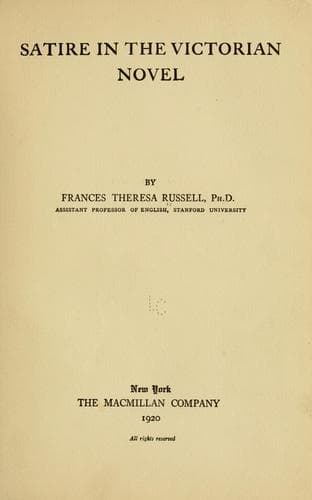
Satire in the Victorian novelRussell, Frances Theresa
History
Satire in the Victorian novel
Russell, Frances Theresa
English fiction -- 19th century -- History and criticism; Satire, English -- History and criticism; Thesis (Ph. D.)
Two of them, _Maid Marian_ and _The Misfortunes of Elphin_, are in
historic costume, and thus afford a chance for the inverted satire that
comes from a contrast between past and present, not to the advantage of
the latter. The other five are all domiciled in contemporary English
house parties; in Hall, Court, Abbey, Castle, or Grange. These are
not, however, the habitations of the conventional citizen. They are
“Headlong,” “Nightmare,” “Crochet.” They harbor all sorts of whimsies
and fads. Those assembled dine, drink, and talk. Between meals they
have a few adventures, not recounted for their own sake, but that of
the additional talk they will bring forth.[92] Though the repartee of
these dramatized Imaginary Conversations is always at concert pitch,
it harmonizes with the whimsically theatrical setting; and the _toute
ensemble_ edifies while it sparkles, like a set of fireworks displaying
maxims of intellectual wit as they explode.
The characters themselves wear their very names as satiric labels. Mr.
Feathernest, Mr. Dross, Mrs. Pinmoney, the Honorable Mr. Listless, Sir
Oliver Oilcake, the Reverends Gaster, Grovelgrub, Vorax, are ticketed
after the fashion inherited from the Morality Plays, a device that
distills a quaint mediæval odor on the nineteenth-century air, and
persists only in some of Trollope’s minor characters.
Of all these people exploiting all their “humours” Peacock is the
ever amused spectator. He speaks ironically through the voice of the
artlessly ambitious Squire Crochet:[93]
“The sentimental against the rational, the intuitive against
the inductive, the ornamental against the useful, the intense
against the tranquil, the romantic against the classical; these
are great and interesting controversies, which I should like,
before I die, to see satisfactorily settled.”
It is because of this effect of inconsequent raillery, doubtless,
that Peacock appears to lack humanity,[94] and to laugh without
responsibility.[95] But one feels that such criticisms would not have
ruffled the twinkling serenity of his placid spirit; that he would not
have deplored the loss of power nor demurred at the penalty. He was a
born sportsman. The hunting was good. Pleasure to him was in pursuit
more than possession. Having had the fun, he would willingly give away
his bag of game before he went home.
One turns with an especial interest to the belated _Gryll Grange_
to see what change there may be thirty years after, but finds little
more than the natural mellowing influence of time. He is indeed
“satirist to the last,” albeit he is disposed to use “more oil and less
vinegar.”[96]
If Peacock is Horatian, without the Roman’s sense of realism, Butler
is more of a Juvenal, as the latter might have been, perhaps, had he
lived under Victoria instead of Domitian. The wind of invective is now
tempered, not to the shorn lamb, but to the modern prejudice against
the rudeness of tempests unmitigated by sunshine.
Public-domain text, read in full here on John Shaqi.
Reviews
Reviews
No reviews yet
Be the first to share your thoughts on this work.
Join the Discussion
Join the discussion
Sign in to leave a comment or review.
Sign InorCreate an account