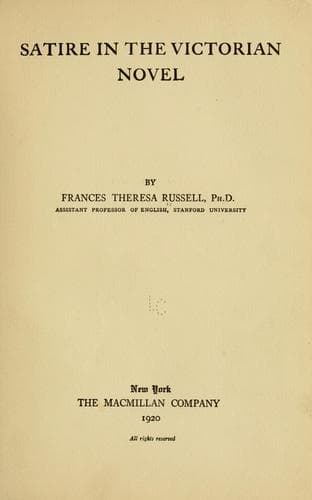
Satire in the Victorian novelRussell, Frances Theresa
History
Satire in the Victorian novel
Russell, Frances Theresa
English fiction -- 19th century -- History and criticism; Satire, English -- History and criticism; Thesis (Ph. D.)
But the idea itself was a premature blossom, and the winds of March,
though late Victorian, were ruthless. About that time, however, it was
the much more massive figure of Ibsen that happened to stand in the
main current of the blasts, and Butler was merely blown aside and left
until Shaw and the Twentieth Century came along and picked him up. One
of his recent biographers has a serious time trying to establish him as
the laws of chronology would dictate, and finally decides it cannot be
done:[101]
“How is it possible to fit a man like Butler, * * * into any
system, * * * how are we to classify one who, above all others,
belonged to no school, was traceable, it may fairly be said, to
no influence at all _direct_ in character, looking back to, and
fitting in with, none of those particular habits of thought at
any rate in the age just preceding and merging into his own? On
an external view, of course, it might be maintained that Butler
harmonized with the solid, scientific background of Victorian
thought--harmonized with it, yet was not of it. Again * * * one
might quite easily say that Samuel Butler stood outside the
Victorian system. And this would be the truest description of
him.”
The parallel noted above between the next two on the list, Lytton and
Disraeli, is more applicable to their work in the realistic field than
in this, for the reason already stated, that Lytton’s one contribution,
_The Coming Race_, is more akin to Butler’s, both in date and design.
Accident rather than enterprise led to the discovery of Lytton’s
Utopian people, the Vrilya, for they inhabit the concave inner surface
of our own planet, and are to be reached only through a subterranean
chasm leading down from the depths of a mine. The citizens of this
highly cultivated nation regard the English intruder as a primitive
barbarian, and despise him for his ignorance and his crude, carnivorous
habits. Deciding, however, to spare his life and risk his presence
until proved contaminating and pernicious, they proceed to educate him
by means of the Vril Trance, a sort of telepathic radio-activity. The
process is mutual, except that they accomplish more,--“partly because
my language was much simpler than theirs, comprising far less of
complex ideas; and partly because their organization was, by hereditary
culture, much more ductile, and more readily capable of acquiring
knowledge than mine.”[102]
Public-domain text, read in full here on John Shaqi.
Reviews
Reviews
No reviews yet
Be the first to share your thoughts on this work.
Join the Discussion
Join the discussion
Sign in to leave a comment or review.
Sign InorCreate an account