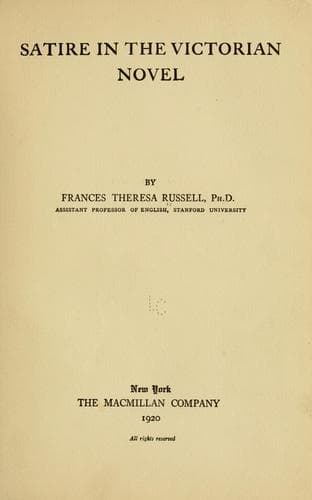
Satire in the Victorian novelRussell, Frances Theresa
History
Satire in the Victorian novel
Russell, Frances Theresa
English fiction -- 19th century -- History and criticism; Satire, English -- History and criticism; Thesis (Ph. D.)
It is natural that the burlesque should have been a favorite satiric
mode from Aristophanes to Rostand and Shaw. The wit it requires is
imitative rather than creative, and its appeal is instantaneous.
It is also natural that it should manifest itself at the beginning of
a writer’s career, and form a prelude to greater achievement. This is
the case for good and sufficient psychological reasons. In youth the
exuberant and undisciplined spirit, not yet checked by the reins of
reality, riots in the glory of extravagance; the inventive faculty
is awake but unfurnished by experience with material for original
creation; the critical scent is keen but unpracticed, and impatient
of sober, qualified judgment.[114] Such a condition is prime for
the production of a _Love’s Labour’s Lost_, a _Joseph Andrews_, a
_Northanger Abbey_, a _Pickwick_, a _Barry Lyndon_, a _Shaving of
Shagpat_; to be followed by _Twelfth Night_, _Tom Jones_, _Emma_,
_David Copperfield_, _Vanity Fair_, _The Egoist_.
Thackeray’s apprenticeship at this desk was rather unduly prolonged,
covering about half the period of his literary activity; and its output
is difficult to segregate on account of the ambiguous description of
much of his early work. But from the large mass of sketches, essays,
skits, stories, perhaps half a dozen may be selected as being fairly
within the limits of satirico-romance.
Two of them, the _Hoggarty Diamond_ and the _Yellowplush Papers_, are
on the border line, included here only because too exaggerated and
irresponsible to be otherwise classed. The same might be said of _Barry
Lyndon_, which is not far from being a real novel. Yet perhaps none
of these are more “grotesque” than some phases of legitimate fiction.
Much of their humor comes from the dramatic monologue device. Five are
roughly definable as burlesques: three--_Catherine_, _A Legend of the
Rhine_, and _The Rose and the Ring_, of types; the other two, _Novels
by Eminent Hands_, and _Rebecca and Rowena_, of individuals; yet here
again, classification is misleading, as these latter are versus the
_forms_ of certain productions rather than their _authors_.
Public-domain text, read in full here on John Shaqi.
Reviews
Reviews
No reviews yet
Be the first to share your thoughts on this work.
Join the Discussion
Join the discussion
Sign in to leave a comment or review.
Sign InorCreate an account