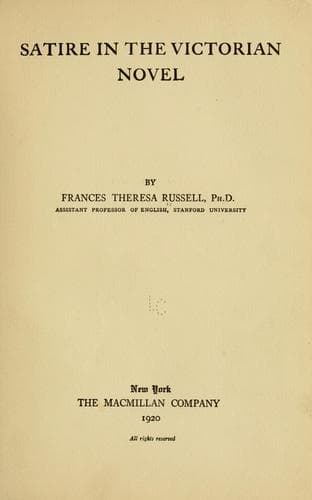
Satire in the Victorian novelRussell, Frances Theresa
History
Satire in the Victorian novel
Russell, Frances Theresa
English fiction -- 19th century -- History and criticism; Satire, English -- History and criticism; Thesis (Ph. D.)
Meredith’s _Farina_ is an interesting companion piece to Thackeray’s
Rhine Legend, both having a Teutonic and chivalric background, and
one might perhaps find a closer parallel there than in the one chosen
by Moffat, who traces “reminiscences of Peacock in the fantastic
element which occasionally crops up,” in Meredith, and points out
that the idea underlying _Farina_ and _Maid Marian_ is “substantially
the same--an attempt to reproduce with gentle satire, the medieval
romance of sentiment and gay adventure.” It is true, however, that _A
Legend of the Rhine_ differs from both these in its mocking parade of
anachronisms and telescoped chronology. It was “many, many hundred
thousand years ago” that Thackeray’s German knight was pricking o’er
the plain, but it was in the time of Richard the Lion-Hearted, and “on
the cold and rainy evening of Thursday, the twenty-sixth of October.”
In addition to his full armor he was equipped with an oiled silk
umbrella and a bag with a brazen padlock.
On a subsequent adventure he halts at a wayside shrine covered with
“odoriferous cactuses and silvery magnolias,” and recites “a censer, an
ave, and a couple of acolytes before it.” A victim of his mighty lance
wishes for a notary-public to take down his dying deposition. And a
lost champion is advertised for in the _Allgemeine Zeitung_.
_The Shaving of Shagpat_ out-Herods Herod in Arabian Nightism, and
is not devoid of satiric pith, but we are expressly forbidden by the
author himself to allegorize his geyser of ebullient mirth. The humor
is Rabelaisian--or American--in its pure love of size; it floats in a
gigantic, inflated balloon, to which a small basket of mental cargo is
attached. In this, however, is wrapped up the very important secret
that continuous laughter releases one from enchantment and restores
one’s true form.
The romantic satirist must have, like any other compound, certain more
or less inconsistent traits. There must be the inventive wit of romance
plus the shrewd logic of satire. Yet this rare combination does not
insure the best satiric results. Indeed the contrary is more likely to
be the case, as the union at best is somewhat adventitious.
Then, too, there must be a degree of exaggeration, with the strain on
our credulity so evenly distributed that it is not felt. The sound
sense that satire calls for[115] must maintain her operations, the
while she is masquerading as arrant nonsense.
Finally there is the dilemma encountered by the dramatist,--the
necessity of concentrating high lights as life never does, yet
preserving sufficient effect of dullness and vapid inanity to simulate
reality as we know it.
Public-domain text, read in full here on John Shaqi.
Reviews
Reviews
No reviews yet
Be the first to share your thoughts on this work.
Join the Discussion
Join the discussion
Sign in to leave a comment or review.
Sign InorCreate an account