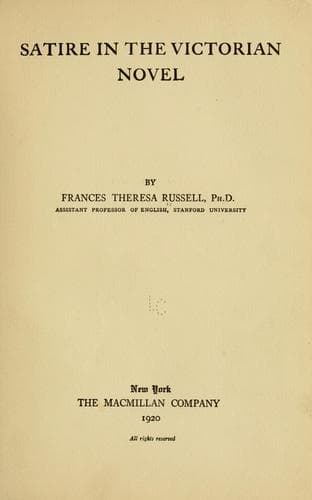
Satire in the Victorian novelRussell, Frances Theresa
History
Satire in the Victorian novel
Russell, Frances Theresa
English fiction -- 19th century -- History and criticism; Satire, English -- History and criticism; Thesis (Ph. D.)
Another reason for the prejudice against ironic language may be that it
is popularly supposed to emanate from a caustic soul, with leanings
toward cynicism; an error due to a narrow identification of irony with
its extreme right wing,--sarcasm, which is indeed, as its etymology
would signify, a flesh-tearing, or at least heart-rending, performance,
belonging, as Bishop Hall would say, to the toothed division of satire.
But on the extreme left sits banter, entirely amiable and even
affectionate. “You scamp, you rascal, you young villain!” is a favorite
way of expressing parental pride and tenderness. Reticent youth
apostrophizes his cherished friend as an “old fraud.” “Philosophic
irony,” says Anatole France, “is indulgent and gentle.”[168] And
Symonds[169] describes Ariosto as watching “the doings of humanity
with a genial half smile, an all pervasive irony that had no sting
in it.” Ranging thus from the playful to the ferocious, irony is at
its best when not too near either margin, having in itself more point
than banter and more polish than sarcasm. “They are all,” says another
critic,[170] “with others of the family, in the regular service of
Satire.”
The metaphor of service may be allowed, in that satire, being the
largest and most general type, includes the others. The relationship
may be stated more literally by saying that irony is the form of
humorous criticism which is expressed through innuendo, partly because
of preference for verbal inversion, and partly in recognition of the
topsy-turvydom of life. All irony is therefore satirical, though not
all satire is ironical. The ironist conveys his own point of view by
stating another’s, condemning by appearing to approve, or _vice
versa_. Boisterousness and didacticism are foreign to irony and not
to be feared so long as it is dominant. Perfection in its employment
indicates that complete self-control which is supposed to be a
patrician trait.
This does not mean, however, that ironic usage or attitude has been
confined to the upper social stratum as its special prerogative.
Nietzsche may indeed exclaim, “We should look upon the needs of the
masses with ironic compassion: they want something which we have
got--Ah!” But these compassionated masses have themselves been capable
of the retort ironic, and have had also their spokesmen, from Lucian
to Galsworthy. In _The Cock_, Lucian gives an ironic enumeration of
the dangers and troubles of the rich and powerful, and displays the
advantage of being poor and obscure. In _The Ferry_, Mycellus, the
cobbler, voices an ironic lament on leaving life, and parodies the
regrets of the wealthy:[171]
Public-domain text, read in full here on John Shaqi.
Reviews
Reviews
No reviews yet
Be the first to share your thoughts on this work.
Elsewhere in the archive
Join the Discussion
Join the discussion
Sign in to leave a comment or review.
Sign InorCreate an account