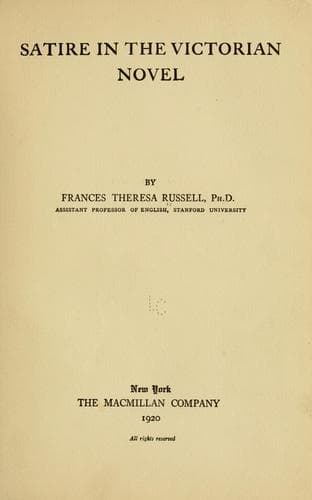
Satire in the Victorian novelRussell, Frances Theresa
History
Satire in the Victorian novel
Russell, Frances Theresa
English fiction -- 19th century -- History and criticism; Satire, English -- History and criticism; Thesis (Ph. D.)
“To be born the son of a Middlemarch manufacturer, and the
inevitable heir to nothing in particular, while such men as
Mainwaring and Vyan--certainly life was a poor business, when
a spirited young fellow, with a good appetite for the best of
everything, had so poor an outlook.”
Of contrasting caliber is Adam Bede, whose vision is turned outward and
even upward, instead of altogether inward; and whose survey causes a
feeling of modesty rather than injured conceit.[226]
“Adam, I confess, was very susceptible to the influence of rank,
and quite ready to give an extra amount of respect to every one
who had more advantages than himself, not being a philosopher,
or a proletaire with democratic ideas, but simply a stout-limbed
clever carpenter with a large fund of reverence in his nature,
which inclined him to admit all established claims unless he saw
very clear grounds for questioning them.”
George Eliot was held in high esteem by George Meredith; and the
two were indeed akin in outlook, and very much so in the matter of
ironic usage, in spite of their wide difference in general style. But
the Meredithian solution is at once more saturated and more subtle,
combined with greater uniformity of effect. This, however, does not
spell monotony, diversity being furnished by range of ideas and breadth
of subject-matter. Meredith has one ironic mold, but into it he pours a
procession of contents of great variety. The tone, it is unnecessary to
say, is undilutedly masculine; so is Eliot’s, except for the presence
of an element usually reckoned as feminine, and mentioned, by a curious
coincidence, in Meredith’s approving characterization of a French
writer. In making out his own preferred list with accompanying reason,
he cites Renan, “for a delicate irony scarcely distinguishable from
tenderness.”[227] In this quality Meredith was by no means lacking,
but his ironic mood was inclined to the caustic and merciless.
One of his devices is to substitute for the old mock-heroic a new
mock-syllogistic, more in accord with modern imagination. The great
doctrine of Natural Selection is applied to human courtship, as
exemplified by one of the Fittest.[228]
“Science thus--or it is better to say, an acquaintance
with science--facilitates the cultivation of aristocracy.
Consequently a successful pursuit and a wresting of her from a
body of competitors, tells you that you are the best man. What
is more, it tells the world so.
“Willoughby aired his amiable superlatives in the eye of Miss
Middleton; he had a leg.”
Under the seductive opportunity of table talk Sir Willoughby again
falls a victim to the inductive method. This time he is airing his
opinion of the French, drawing an elaborate analogy from the character
of a national sample now officiating in the Patterne kitchen.
The general validity of his conclusion is admitted by his modest
secretary:[229]
Public-domain text, read in full here on John Shaqi.
Reviews
Reviews
No reviews yet
Be the first to share your thoughts on this work.
Elsewhere in the archive
Join the Discussion
Join the discussion
Sign in to leave a comment or review.
Sign InorCreate an account