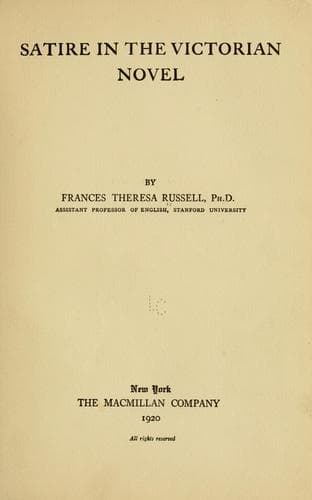
Satire in the Victorian novelRussell, Frances Theresa
History
Satire in the Victorian novel
Russell, Frances Theresa
English fiction -- 19th century -- History and criticism; Satire, English -- History and criticism; Thesis (Ph. D.)
“‘A few trifling errors are of no consequence when you are in
the vein of satire,’ said Vernon. ‘Be satisfied with knowing a
nation in the person of a cook.’”
But Sir Willoughby still has twin peaks of eminence to surmount: one he
achieves when he describes himself to Lætitia as a man of humor; and
the other when he warns Clara to beware of marrying an egoist.
Perhaps the two best understudies in egoism are Wilfred Pole and Victor
Radnor. Wilfred is satisfied with the talents and charm of his Emilia.
And yet[230]
“It was mournful to think that Circumstances had not at the same
time created the girl of noble birth, or with an instinct for
spiritual elegance. But the world is imperfect.”
Both have lofty conceptions of loyalty and sacrifice. In the case of
Wilfred,[231]
“He could pledge himself to eternity, but shrank from being
bound to eleven o’clock on the morrow morning.”
Victor is convinced of his love for Nataly,[232]
“And he tested it to prove it by his readiness to die for her:
which is heroically easier than the devotedly living, and has
a weight of evidence in our internal Courts for surpassing the
latter tedious performance.”
The occasion of the splendid housewarming at Lakelands is made into a
text on the perils of feminism. In a crowded hall--[233]
“Chivalry stood. It is a breeched abstraction, sacrificing
voluntarily and genially to the Fair, for a restoring of the
balance between the sexes, that the division of good things
be rather in the fair ones’ favor as they are to think: with
the warning to them, that the establishment of their claim for
equality puts an end to the priceless privileges of petticoats.
Women must be mad, to provoke such a warning; and the majority
of them submissively show their good sense.” (“With that innate
submissiveness,” speaks up George Eliot, “of the goose, so
beautifully corresponding to the strength of the gander.”)
Another evidence of bewildering perversity is equally apposite to the
present moment of history. The Austrian Lieutenant Jenna is discoursing
on the Italians and the habit of the captured of spending their
enforced solitude in writing Memoirs:[234]
“My father said--the stout old Colonel--‘Prisons seem to make
these Italians take an interest in themselves.’ ‘Oh!’ says my
mother, ‘why can’t they be at peace with us?’ ‘That’s exactly
the question,’ says my father, ‘we’re always putting to them.’
And so I say. Why can’t they let us smoke our cigars in peace?”
But England does not lag behind in the matter of the application of the
intellect to practical questions. The country squires are excited over
the approach of the open game season; moreover,--[235]
Public-domain text, read in full here on John Shaqi.
Reviews
Reviews
No reviews yet
Be the first to share your thoughts on this work.
Elsewhere in the archive
Join the Discussion
Join the discussion
Sign in to leave a comment or review.
Sign InorCreate an account