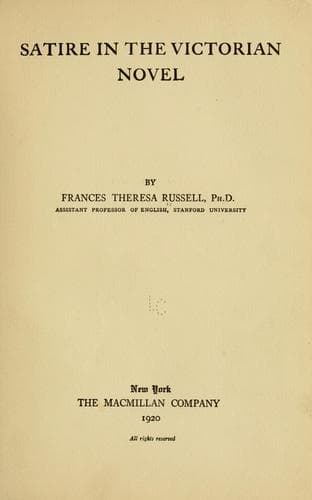
Satire in the Victorian novelRussell, Frances Theresa
History
Satire in the Victorian novel
Russell, Frances Theresa
English fiction -- 19th century -- History and criticism; Satire, English -- History and criticism; Thesis (Ph. D.)
“The entire land (signifying all but all of those who occupy the
situation of thinkers in it) may be said to have been exhaling
the same thought in connection with September. Our England holds
possession of a considerable portion of the globe, and it keeps
the world in awe to see her bestowing so considerable a portion
of intelligence upon her recreations. To prosecute them with her
whole heart is an ingenious exhibition of her power.”
It is naturally the fate of the active to suffer from Philistine
misapprehension, particularly when the activity is racial:[236]
“Foreigners pertinaciously misunderstand us. They have the
barbarous habit of judging by results. Let us know ourselves
better. It is melancholy to contemplate the intrigues, and vile
designs, and vengeances of other nations; and still more so,
after we have written so many pages of intelligible history, to
see them attributed to us. Will it never be perceived that we do
not sow the thing that happens?”
This rhetorical irony, which we have found so widely distributed, is
a sign of temperament at the most, and at the least only of habit,--a
mannerism of style. Philosophical irony, a sense of the irony of
life, is an indicator of character and the whole interpretation of
experience. The two kinds may or may not coincide. It happens, for
instance, that the two great ironists who inclose the Victorian period
like a pair of chronological brackets, illustrate them separately. Jane
Austen is habitually ironic in speech, but no novel of hers manifests
an idea of the irony of fate. Her situations are too simple, too
blandly logical, to be devised by a Destiny either impishly malicious
or cruelly malignant. But Thomas Hardy takes all his reasonable logic
and bland simplicity out in language. He seldom introduces the caustic
reflection. There is little of the acrid in the flavor of his style.
It is all poured into the story. The conditions he portrays convey
their own poignancy, and tell their own tale of gratuitous failure and
superfluous sacrifice.
Public-domain text, read in full here on John Shaqi.
Reviews
Reviews
No reviews yet
Be the first to share your thoughts on this work.
Elsewhere in the archive
Join the Discussion
Join the discussion
Sign in to leave a comment or review.
Sign InorCreate an account