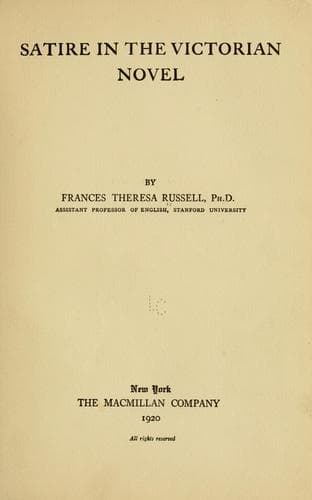
Satire in the Victorian novelRussell, Frances Theresa
History
Satire in the Victorian novel
Russell, Frances Theresa
English fiction -- 19th century -- History and criticism; Satire, English -- History and criticism; Thesis (Ph. D.)
Of this sharp impression of life as consisting of the nearly-achieved
or barely-failed, there are indications here and there in mid-century
fiction, but no thoroughgoing exponent, because none of that
unqualified pessimism which acknowledges irrationality as the presiding
genius of the world. It is natural that in Disraeli, Brontë, Kingsley,
circumstantial irony should be as snakes in Iceland; and that Lytton,
Gaskell, Dickens, Thackeray, Reade, should furnish a pair of white
crows apiece. It is interesting though also not astonishing to find
that out of about three dozen culled examples, Peacock and Butler not
counted because they do not work in the medium of normal circumstance,
Meredith leads with nearly one-third the total amount, Eliot being
a close second, and Trollope a lagging third. Yet these three are
decidedly anti-ironic in general belief; shown both by actual testimony
and by implication. The former comes, as would be supposed, from
Meredith. Writing to a friend and alluding to the weakness of old age,
he says,--[237]
“We who have loved the motion of legs and the sweep of the
winds, we come to this. But for myself, I will own that it is
the natural order. There is no irony in Nature.”
In his last novel he gives a backhanded thrust at the ironic philosophy
in his favorite equivocal fashion:[238]
“We are convinced we have proof of Providence intervening when
some terrific event of the number at its disposal accomplishes
the thing and no more than the thing desired.”
In the same story the motive and emotion of the bridegroom is thus
described:[239]
“A sour relish of the irony in his present position sharpened
him to devilish enjoyment of it, as the finest form of loathing:
* * * He had cried for Romance--here it was!”
But the author makes it clear that this irony is subjective. The
objective complement to it arrives later, and its real name is Nemesis.
Subjective also is it in the one account we have from George Eliot:[240]
“But anyone watching keenly the stealthy convergence of human
lots, sees a slow preparation of effects from one life on
another, which tells like a calculated irony on the indifference
or the frozen stare with which we look at our unintroduced
neighbor. Destiny stands by sarcastic with our _dramatis
personæ_ folded in her hand.”
That is, our ignorance makes a dramatic irony out of a situation in
itself a link in the logical chain of cause and effect.
The implication that to the Victorians life is on the whole rational
rather than ironic is made by the fact that the ironic situations are
incidental, and the conclusions are based on poetic justice, whether
happy or tragic, and not on ironic injustice. It may be worth noting
that these various situations seem divisible into three or four
classes, and that such division serves to bring some order out of the
chaos of their multiplicity.
Public-domain text, read in full here on John Shaqi.
Reviews
Reviews
No reviews yet
Be the first to share your thoughts on this work.
Elsewhere in the archive
Join the Discussion
Join the discussion
Sign in to leave a comment or review.
Sign InorCreate an account