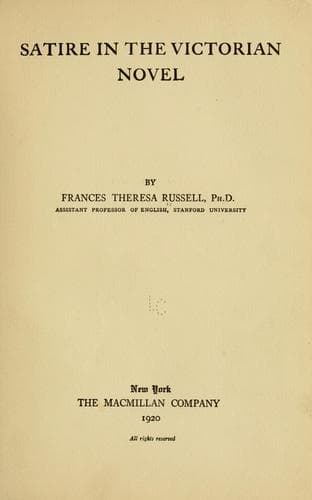
Satire in the Victorian novelRussell, Frances Theresa
History
Satire in the Victorian novel
Russell, Frances Theresa
English fiction -- 19th century -- History and criticism; Satire, English -- History and criticism; Thesis (Ph. D.)
There is first the irony already mentioned as dramatic, where ignorance
is not bliss. Such is the case in Lytton’s _Alice_, when Maltravers
falls in love with his own unknown daughter, an Œdipean tragedy being
averted by timely information. A similar relationship with opposite
effect is that of Harold Transome, exasperating with warnings of
exposure the slippery scoundrel Jermyn, until he forces the incredible
exposure of his own social position. Even more ironic is that behavior
which in ignorant zeal precipitates the very calamity it strives to
avoid. Thus does Mrs. Tulliver, “a hen taking to reflection on how
to prevent Hodge from wringing her neck,” when she adroitly tries to
persuade Wakem not to buy the Mill, thereby putting the notion of doing
it into his head. Lady Glencora, in _Phineas Finn_, pleading with
Madame Max not to marry the Duke of Omnium, unaware of her already
made decision not to do so, very nearly meets with the same kind of
gratuitous failure. Of a different order is the use of secret knowledge
to extract an advantage from the ignorant adversary who misunderstands
the allusions; as Sandra Belloni, arousing Mr. Pole’s enthusiasm for
her as a daughter-in-law, good enough for any man indeed,--except his
unsuspected self, who was the only one desired. At three fine banquets
dramatic irony sits as an unwelcome guest: at Arthur Donnithorne’s
birthday feast, where the warm tribute paid him by Adam Bede and Mr.
Poyser would have turned to ashes in their mouths had they known the
truth; at Mr. Vane’s dinner for Peg Woffington, at which his innocent
wife appears just in time to assume all the honors to herself; and at
the Jocelyn party, where the daughters of the great Mel have him to
digest.
Another sort of irony comes from the reversed wheel of fortune. This
is also dramatic, being in fact the keynote of the mediæval idea of
tragedy, though all such reversal is not ironic. Authur Clennam in
the Marshalsea might be an instance, albeit less perfect than William
Dorrit fancying himself there when he was really in the perfectly
appointed Merdle dining room. There is a double reversal of expectation
that turns Fred Vincy into a passable success, through being cheated
out of his legacy, while Dorothea Brooke and Tertius Lydgate are
thwarted into comparative failure. Another subdivision is that
complete fall in which the victim does, and gladly, the thing he has
previously sworn he would in no wise ever do; witness Sir Willoughby in
triumph over the winning of the lady with brains, afterward to learn
“the nature of that possession in the woman who is our wife.”
Public-domain text, read in full here on John Shaqi.
Reviews
Reviews
No reviews yet
Be the first to share your thoughts on this work.
Elsewhere in the archive
Join the Discussion
Join the discussion
Sign in to leave a comment or review.
Sign InorCreate an account