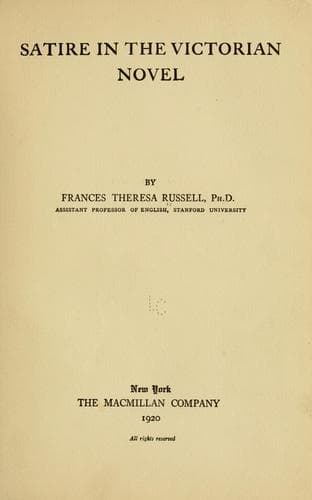
Satire in the Victorian novelRussell, Frances Theresa
History
Satire in the Victorian novel
Russell, Frances Theresa
English fiction -- 19th century -- History and criticism; Satire, English -- History and criticism; Thesis (Ph. D.)
Then there is the granted desire; as if mother Fate hearing her
children beg for poisoned candy said, Well, take it then, and see how
you like it. Lady Mason, in _Orley Farm_, Mrs. Transome, Sir Richard
Feverel, are all devoted parents who are allowed to have their own
way in plans for their children, and merely asked to abide by the
consequences. The death of Raffles comes most opportunely for Mr.
Bulstrode, and seals his doom.
The irony of the lost opportunity is hard to distinguish from just
retribution. Philip Beaufort, killed on his way to a belated deed of
duty to his family; Trollope’s Claverings and Bertrams; Godfrey Cass,
Lord Fleetwood, Edward Blancove, all are made to feel the ironic
undercurrent of that water the mill will never grind with, because it
has passed.
In addition to these _exempla_, attention might be called to a trio of
ironic titles: _Great Expectations_, _Beauchamp’s Career_, and _One of
Our Conquerers_.
Though all the novelists indulge at times in the use of irony, Meredith
alone offers a definition. In one place in the _Essay on Comedy_,
he characterizes it as the honeyed sting which leaves the victim in
doubt as to having been hurt. In another, he expands the idea:
“Irony is the humour of satire; it may be savage as in Swift,
with a moral object, or sedate, as in Gibbon, with a malicious.
The foppish irony fretting to be seen, and the irony which
leers, that you shall not mistake its intention, are failures in
satiric effort pretending to the treasures of ambiguity.”
Some there are who are not quite guiltless of these failures, but
Meredith is not one of them. He is unique also, except for the
corroboration of George Eliot, in making the ironic interpretation of
life in itself an object of satire, in so far as it is brought forward
as an excuse for our deficiencies, for then it betrays a certain
weakness in our mental processes. For this he has one direct spokesman
and two or three dramatic examples. The former is the incisive
Redworth, who is exasperated at this vicarious refuge claimed by needy
human nature.[241]
“‘Upon my word,’ he burst out, ‘I should like to write a book of
Fables, showing how donkeys get into grinding harness, and dogs
lose their bones, and fools have their sconces cracked, and all
run jabbering of the irony of Fate, to escape the annoyance of
tracing the causes. And what are they? Nine times out of ten,
plain want of patience, or some debt for indulgence, * * * It’s
the seed we sow, individually or collectively.’”
Chief of the latter--the dramatic examples--is a youth who, just
returning from his father’s funeral, with bitter prospects ahead,
encounters a being more wretched than himself, a forsaken young woman
shelterless, and desperately ill.[242]
Public-domain text, read in full here on John Shaqi.
Reviews
Reviews
No reviews yet
Be the first to share your thoughts on this work.
Elsewhere in the archive
Join the Discussion
Join the discussion
Sign in to leave a comment or review.
Sign InorCreate an account