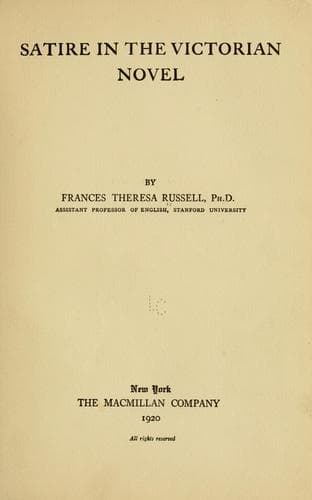
Satire in the Victorian novelRussell, Frances Theresa
History
Satire in the Victorian novel
Russell, Frances Theresa
English fiction -- 19th century -- History and criticism; Satire, English -- History and criticism; Thesis (Ph. D.)
“Evan had just been accusing the heavens of conspiring to
disgrace him. Those patient heavens had listened, as is their
wont. They had viewed and not been disordered by his mental
frenzies. It is certainly hard that they do not come down to us,
and condescend to tell us what they mean, and be dumb-foundered
by the perspicuity of our arguments--the argument, for instance,
that they have not fashioned us for the science of the shears,
and do yet impel us to wield them.”
A little later in the same story is a bit of “eloquent and consoling
philosophy” on a happy juxtaposition of the meat and the eaters.[243]
“A thing has come to pass which we feel to be right! The
machinery of the world, then, is not entirely dislocated: there
is harmony, on one point, among the mysterious powers who have
to do with us.”
Another deeply meditative young man is Algernon Blancove. On the very
point of turning over a new leaf, he has the misfortune to lose a wager
of a thousand pounds,--which he did not have in the first place.[244]
“A rage of emotions drowned every emotion in his head, and
when he got one clear from the mass, it took the form of a
bitter sneer at Providence, for cutting off his last chance of
reforming his conduct and becoming good. What would he not have
accomplished, that was brilliant, and beautiful, and soothing,
but for this dead set against him!”
With a gentler touch Clotilde is pictured, on hearing of the disaster
to Alvin, as venting the “laugh of the tragic comedian.”[245]
“She laughed. The world is upside down--a world without light,
or pointing finger, or affection for special favorites, and
therefore bereft of all mysterious and attractive wisdom, a
crazy world, a corpse of a world--if this be true!”
One more angle has Meredith from which to view this subject, and this
shows up the absurdity of the opposite type,--the superior philosopher
who disdains to apply the ironic explanation to his own affairs, but
prides himself on his detached, Olympian, ironic view of the cosmos.
This spirit is incarnate in the wise youth, Adrian Harley.[246]
“He had no intimates except Gibbon and Horace, and the society
of these fine aristocrats of literature helped him to accept
humanity as it had been, and was; a supreme ironic procession,
with laughter of Gods in the background. Why not laughter of
mortals also?”
From the tranquillity of this calm eminence he observes the mortal
excitement produced by the news of Richard’s marriage.[247]
“When one has attained that felicitous point of wisdom from
which one sees all mankind to be fools, the diminutive objects
may make what new moves they please, one does not marvel at
them; their sedateness is as comical as their frolic, and their
frenzies more comical still.”
Public-domain text, read in full here on John Shaqi.
Reviews
Reviews
No reviews yet
Be the first to share your thoughts on this work.
Elsewhere in the archive
Join the Discussion
Join the discussion
Sign in to leave a comment or review.
Sign InorCreate an account