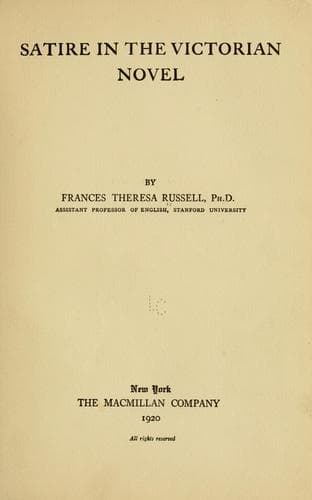
Satire in the Victorian novelRussell, Frances Theresa
History
Satire in the Victorian novel
Russell, Frances Theresa
English fiction -- 19th century -- History and criticism; Satire, English -- History and criticism; Thesis (Ph. D.)
Whether or not there is such an actuality as an Ironic Fate, upon whom
mortals may blame their failures, or against whom they are doomed to
strive in vain, is as speculative a question as any in metaphysics.
The ironist is as dogmatic as the theist; and he no doubt gets as much
satisfaction from his denial of a rationally ordered universe, as
the other does from his assertion of it. To be able to fling back a
jest into the face of the Sphinx is undeniably a poor equivalent for
guessing her riddle, but it at least helps to take the edge off her
inscrutability.
In his _La Satire en France_, Lenient makes irony the opposite
of enthusiasm, and emphasizes the fact and the necessity of their
perennial alternation, like the recurrence of day and night. It would
indeed be a fearful world whose passive, indifferent night was
succeeded by no bright, clear, active day. But it would also be a
wearisome world whose glare never merged into the refreshing season
of dusky shadows, quiet half-tones, and twinkling stars. It is well
that they are reciprocal and that “_sous ces noms divers reproduèra
l’eternelle antethèse qui s’agite au fond de toute sociêtê_.”
PART III
OBJECTS
CHAPTER I
INDIVIDUALS
As the target to the missile, so is its object to satire. A target
is in itself a thing of sufficient identity to be amenable to
definition,--even if that can be no more precise than “something aimed
at.” But in the concrete there are targets and targets. So, while the
satirized may be reduced to an abstract entity, as deception or some
other ubiquitous trait of human nature, there exist in fact as many
varieties of the satirized as of satirists. Anything which any one may
criticise, if it be subject to humorous treatment, may be a satirical
object.
But since subdivisions are convenient, we make three for this purpose,
which seem fairly inclusive, though not at all mutually exclusive.
The simplest and narrowest class is that of actual Individuals. The
next is formed by the cohesion of individuals into groups, creating
Institutions. The third is made by the artistic conversion of
individuals into fictitious characters, sufficiently artificial to be
designated as Types,--more or less complex, according to the nature
of their creator, but never entirely simple, if they are fashioned of
human stuff.
Public-domain text, read in full here on John Shaqi.
Reviews
Reviews
No reviews yet
Be the first to share your thoughts on this work.
Elsewhere in the archive
Join the Discussion
Join the discussion
Sign in to leave a comment or review.
Sign InorCreate an account