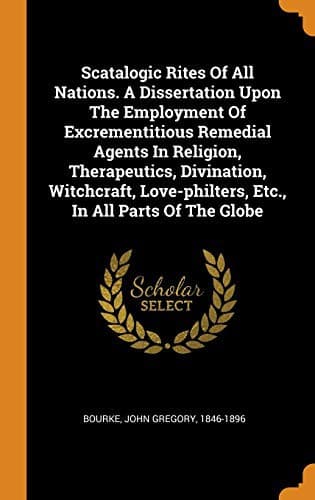
Scatalogic Rites of All Nations: A dissertation upon the employment of excrementitious remedial agents in religion, therapeutics, divination, witchcraft, love-philters, etc., in all parts of the globeBourke, John Gregory
Religion
Scatalogic Rites of All Nations: A dissertation upon the employment of excrementitious remedial agents in religion, therapeutics, divination, witchcraft, love-philters, etc., in all parts of the globe
Bourke, John Gregory
Scatology
“Beware thee that thou mie not where the hound mied; some men say that
there a man’s body changeth so that he may not, when he cometh to bed
with his wife, bed along with her.”—(De Med. de Quad. of Sextus Placitus,
from “Saxon Leechdoms,” vol. i. p. 365.)
XXXI.
SIBERIAN HOSPITALITY.
A curious manifestation of hospitality has been noticed among the
Tchuktchi of Siberia: “Les Tschuktschi offrent leurs femmes aux
voyageurs; mais ceux-ci, pour s’en rendre dignes, doivent se soumettre à
une épreuve dégoûtante. La fille ou la femme qui doit passer la nuit avec
son nouvel hôte lui présente une tasse pleine de son urine; il faut qu’il
s’en rince la bouche. S’il a ce courage, il est regardé comme un ami
sincère; sinon, il est traité comme un ennemi de la famille.”—(Dulaure,
“Des Divinités Génératrices,” Paris, 1825, p. 400.)
Among the Tchuktchees of Siberia, “it is a well known custom to use
the urine of both parties as a libation in the ceremony; and likewise
between confederates and allies, to pledge each other and swear eternal
friendship.”—(“In the Lena Delta,” Melville, p. 318.)
The presentation of women to distinguished strangers is a mark of savage
hospitality noted all over the world, but never in any other place with
the above peculiar accompaniment; yet Mungo Park assures his readers
that, during his travels in the interior of Africa, a wedding occurred
among the Moors while he was asleep. He was awakened from his doze by an
old woman bearing a wooden bowl, whose contents she discharged full in
his face, saying it was a present from the bride.
Finding this to be the same sort of holy water with which a Hottentot
priest is said to sprinkle a newly married couple, he supposed it to be
a mischievous frolic, but was informed that it was a nuptial benediction
from the bride’s own person, and which, on such occasions, is always
received by the young unmarried Moors as a mark of distinguished
favor.—(Quoted in Brand, “Popular Antiquities,” London, 1849, vol. ii. p.
152, article “Bride-Ales.” See also Mungo Park’s “Travels in Africa,” New
York, 1813, p. 109.)
Public-domain text, read in full here on John Shaqi.
Reviews
Reviews
No reviews yet
Be the first to share your thoughts on this work.
Elsewhere in the archive
Join the Discussion
Join the discussion
Sign in to leave a comment or review.
Sign InorCreate an account