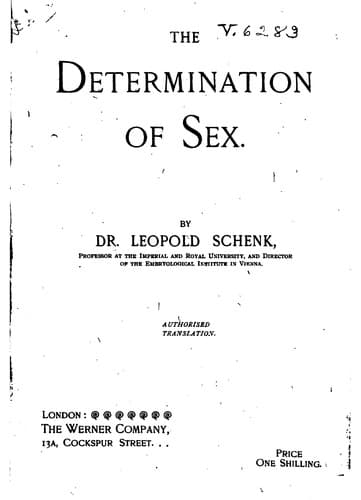
Schenk's Theory: The Determination of Sex — John Shaqi
Schenk's Theory: The Determination of SexSchenk, Samuel Leopold
Science
Schenk's Theory: The Determination of Sex
Schenk, Samuel Leopold
Sex determination, Genetic; Sex preselection
Under these circumstances, the symptoms of rutting are sufficiently
distinctly marked to make it possible, as Thury suggests, to determine
the advanced state of ripeness or its commencement in the ova. But it
is scarcely possible to say when the period of ripeness commenced in
this ovum or that. An ovum which had begun to ripen early may, at
the beginning of the rutting time, have attained to the condition of
a male-producing ovum. At the same time, others which are fertilized
at the conclusion of the rutting, but had begun to ripen comparatively
late, may, at the end of the rutting time, not yet have advanced far
enough to be able to develop male individuals.
* * * * *
Thury bases his doctrine on a number of phenomena of the vegetable and
animal world, and upon various experiences in the case of man. He also
adduces many statistical data in explanation and support of his theory.
The observations on plants make it indisputably clear that all the
circumstances which favor growth and ripening are favorable conditions
for the development of male organs. If all these circumstances are
lacking, female organs are produced.
Dark and cold, for instance, cause the male organs to perish. In
recent times a great number of extended studies of the phenomena of
vegetable life in this direction have appeared. I may mention more
particularly the following experiments made by M. von Treskow in
Gorlitz with _Arisæma_ (Verhandlungen des Botanischen Vereins der
Provinz Brandenburg, 1895). This plant first produces male flowers. In
the later year, when it has become larger, it produces female flowers.
The transition from the male flowers of the early stage to the female
flowers of the later stage can be hastened at pleasure by planting in
rich garden mold and manuring with horn shavings. If, on the other
hand, the plant be placed in poor, sandy soil, it reverts to the male
flowers. The same author quotes in his essay a remark of Heyer’s
(Halle, 1884), who declares that no sufficient observations exist
respecting the influence which different situations exert over sex.
I adduce this instance, for the sake of remarking respecting it, that
on this subject also controversies exist, which must be settled by
wider studies of the life of plants.
Cornaz has tried to derive from cows evidence in support of Thury’s
theory. He had twenty-nine cows impregnated with attention to the
rutting time, and from twenty-nine births received twenty-two females
and seven males. Cornaz attested his experiment by a declaration, and
the experiment was repeated in the French state domains.
But the experiment alone was striking enough to invite repetition. It
also met with partial success. But the plan was afterwards entirely
given up, perhaps in consequence of disappointments.
Public-domain text, read in full here on John Shaqi.
Reviews
Reviews
No reviews yet
Be the first to share your thoughts on this work.
Join the Discussion
Join the discussion
Sign in to leave a comment or review.
Sign InorCreate an account