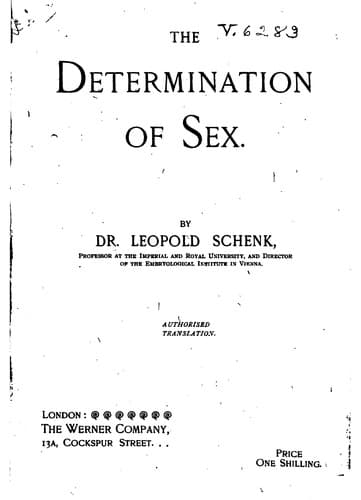
Schenk's Theory: The Determination of SexSchenk, Samuel Leopold
Science
Schenk's Theory: The Determination of Sex
Schenk, Samuel Leopold
Sex determination, Genetic; Sex preselection
In so far as these theories are mere calculations and results which
have originated from comparisons of numbers (the numbers themselves
being in many cases of no practical value), the conclusions reached
may appear to be astonishing, and may be used to support either one
view or another, or to contradict them. Only one fact appears to be
certainly established, that, on an average, under normal circumstances,
the number of male individuals of our population that are born exceeds
the number of females. The difference amounts to a small and variable
number per cent., but in the case of the new-born, the excess is on the
side of the males. (Süssmilch.)
* * * * *
Thus far we have given such data as statistics have furnished. These,
it is true, belong principally to past epochs, and no new results of
this sort have been used by statisticians. But it would be equally
impossible to deduce from new statistics, or from old, or from both
together, any law of nature affecting the question before us.
* * * * *
I shall proceed next to examine the further theories on this subject
with which I have become acquainted from the perusal of the literature
treating of it. With some of the works which I am about to mention I
am acquainted at first hand. Others I know only from quotations found
in various technical publications. I have not attempted to arrange my
materials in any other way.
In the case of the most widely different branches of natural science,
and whether the author’s aim be descriptive or experimental, it is a
common practice to commence with a glimpse at what has been said by the
earliest writers. I shall begin in the same way. I shall, however, not
take into consideration what has been at various times mere folk-lore,
and is only traditionally known, but shall limit myself to such
traditions as have been preserved in writing. I have, besides, already
spoken above of suppositions respecting the origin of sex which appear
to partake of the nature of myths. To these it was impossible to attach
any importance. And the same must be said of other views which belong
to the epoch of the Greek or Latin writers on natural science, and are
so strange that they can be scarcely brought into any agreement with
modern knowledge.
In Ploss’s work ‘_Das Weib in der Natur and Völkerkunde_’ (Woman in
Nature and Popular Tradition), are to be found the various speculations
of different races respecting the origin of sex. Much of this folk-lore
is of a distinctly surprising character, and calculated to afford
the reader considerable amusement. For example, in Servia, if a man
has a stye on his eyelid he comes to the conclusion that his aunt is
pregnant. If the stye is on the upper eyelid, the child will be a male,
if on the lower, a female.
Amongst the Asiatic races religious ceremonies, prayers, and similar
expedients are considered efficacious, and capable of influencing the
sex.
Public-domain text, read in full here on John Shaqi.
Reviews
Reviews
No reviews yet
Be the first to share your thoughts on this work.
Join the Discussion
Join the discussion
Sign in to leave a comment or review.
Sign InorCreate an account