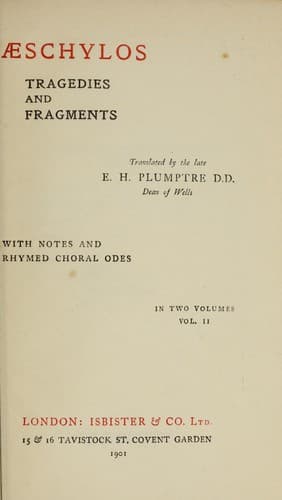
Aeschylus -- Translations into English; Mythology, Greek -- Drama
Both words point to the Sindbad-like stories of distant marvels
brought back by Greek sailors. The Amphisbæna (double-goer), wriggling
itself backward and forward, believed to have a head at each
extremity, was looked upon as at once the most subtle and the most
venomous of serpents. Skylla, already famous in its mythical form from
the story in the _Odyssey_ (xii. 85-100), was probably a “development”
of the monstrous cuttle-fish of the straits of Messina.
Footnote 370:
As in Homer (_Il._ i. 14) so here, the servant of Apollo bears the
wand of augury, and fillets or wreaths round head and arms. The
divining garments, in like manner, were of white linen.
Footnote 371:
If we adopt this reading, we must think of Cassandra as identifying
herself with the woe (Atè) which makes up her life, just as afterwards
Clytæmnestra speaks of herself as one with the avenging Demon
(Alastor) of the house of Atreus (1473). The alternative reading
gives—
“Make rich in woe another in my place.”
Footnote 372:
Perhaps, “in home not mine.”
Footnote 373:
When the victim, instead of shrinking and struggling, went, as with
good courage, to the altar, it was noted as a sign of divine impulse.
Such a strange, new courage the Chorus notices in Cassandra.
Footnote 374:
Possibly,
“My one escape, my friends, is but delay.”
Footnote 375:
The implied thoughts of the words is that Priam and his sons, though
they had died nobly, were yet miserable, and not happy.
Footnote 376:
The Syrian ritual had, it would seem, become proverbial for its lavish
use of frankincense and other spices.
Footnote 377:
The close parallel of Shakespeare's _Henry VI._, Act. v. sc. 6, is
worth quoting—
“The bird that hath been limed in a bush,
With trembling eyes misdoubteth every bush”
Footnote 378:
The older reading gives—
“A shadow might o'erturn it.”
Footnote 379:
Her own doom, hard as it was, touches her less than the common lot of
human suffering and mutability.
Footnote 380:
So far the dialogue has been sustained by the Coryphæos, or leader of
the Chorus. Now each member of it speaks and gives his counsel.
Footnote 381:
The Coryphæos again takes up his part, sums up, and pronounces his
decision.
Footnote 382:
_i.e._, He had had his triumph over her when, forgetful of her
mother's feelings, he had sacrificed Iphigeneia. She has now repaid
him to the full.
Footnote 383:
The third libation at all feasts was to Zeus, as the Preserver or
Guardian Deity. Clytæmnestra boasts that her third blow was as an
offering to a God of other kind, to Him who had in his keeping not the
living, but the dead.
Footnote 384:
Public-domain text, read in full here on John Shaqi.
Reviews
Reviews
No reviews yet
Be the first to share your thoughts on this work.
Elsewhere in the archive
Join the Discussion
Join the discussion
Sign in to leave a comment or review.
Sign InorCreate an account