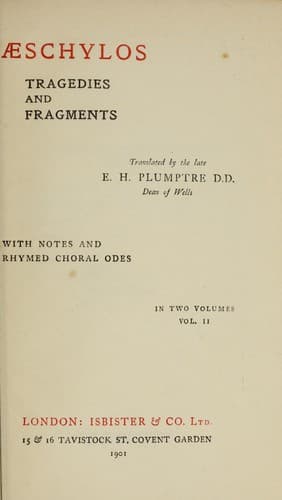
Aeschylus -- Translations into English; Mythology, Greek -- Drama
So in the _Choëphori_ (vv. 351, 476), the custom of pouring libations
on the burial-place of the dead is recognised as an element of their
blessedness or shame in Hades, and Agamemnon is represented as lacking
the honour which comes from them till he receives it at the hand of
Orestes.
Footnote 385:
Incense was placed on the head of the victim. The Chorus tell
Clytæmnestra that she has brought upon her own head the incense, not
of praise and admiration, but of hatred and wrath, as though some
poison had driven her mad.
Footnote 386:
The species of swan referred to is said to be the _Cygnus Musicus_.
Aristotle (_Hist. Anim._ ix. 12) describes swans of some kind as
having been heard by sailors near the coast of Libya, “singing with a
lamentable cry.” Mrs. Somerville (_Phys. Geog._, c. xxxiii. 3)
describes their note as “like that of a violin.” The same fact is
reported of the swans of Iceland and other regions of the far North.
The strange, tender beauty of the passage in the _Phædo_ of Plato (p.
85, a), which speaks of them as singing when at the point of death,
has done more than anything else to make the illustration one of the
commonplaces of rhetoric and poetry.
Footnote 387:
The structure of the lyrical dialogue that follows is rather
complicated, and different editors have adopted different
arrangements. I have followed Paley's.
Footnote 388:
Several lines seem to have dropped out by some accident of
transcription.
Footnote 389:
Agamemnon and Menelaos, as descended from Tantalos, the father of
Pelops.
Footnote 390:
In each case women, Helen and Clytæmnestra, had been the unconscious
instruments of the divine Nemesis, to which the Chorus traces the ruin
of the house of Atreus.
Footnote 391:
Or, with another reading,—
“He (_sc._ the avenging Demon) boasteth in his pride of heart.”
Footnote 392:
It is characteristic of the teaching of Æschylos that the Chorus
passes from the thought of the agency of any lower Power to the
supreme will of Zeus.
Footnote 393:
Or, “Dying, as dies a slave.”
Footnote 394:
Clytæmnestra still harps (though in ambiguous words, which may refer
also to the murder of the children of Thyestes) upon the death of
Iphigeneia as the crime which it had been her work to avenge.
Footnote 395:
Perhaps, “And that, too, not a slave's.”
Footnote 396:
Here the genealogy is carried one step further to Pleisthenes, the
father of Tantalos.
Footnote 397:
Ægisthos, in his version of the story, suppresses the adultery of
Thyestes with the wife of Atreus, which led the latter to his horrible
revenge.
Footnote 398:
The image is taken from the trireme with its three benches full of
rowers. The Chorus is compared to the men on the lowest, Ægisthos and
Clytæmnestra to those on the uppermost bench.
Footnote 399:
Public-domain text, read in full here on John Shaqi.
Reviews
Reviews
No reviews yet
Be the first to share your thoughts on this work.
Elsewhere in the archive
Join the Discussion
Join the discussion
Sign in to leave a comment or review.
Sign InorCreate an account