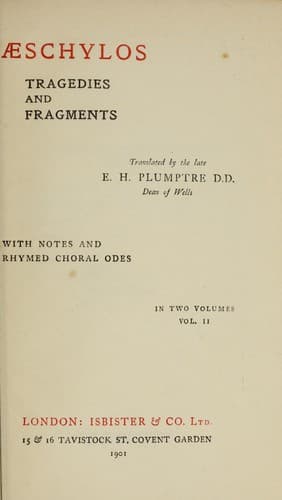
Aeschylus -- Translations into English; Mythology, Greek -- Drama
The earliest occurrence of the proverb with which we are familiar
through the history of St. Paul's conversion, Acts ix. 5, xxvi. 14.
Footnote 400:
The trace-horse, as not under the pressure of the collar, was taken as
the type of free, those that wore the yoke, of enforced submission.
THE LIBATION-POURERS
DRAMATIS PERSONÆ
ORESTES
CLYTÆMNESTRA
PYLADES
ELECTRA
ÆGISTHOS
_Nurse_
_Servant_
_Chorus of Captive Women_
_ARGUMENT.—It came to pass, after Agamemnon had been slain, that
Clytæmnestra and Ægisthos ruled in Argos, and all things seemed to go
well with them. Orestes, who was heir to Agamemnon, they had sent away
to the care of Strophios of Phokis, and there he abode. Electra, his
sister, mourned in secret over her father's death, and prayed for
vengeance, but no avenger came. And when Orestes grew up to man's
estate, he went to ask counsel of the God at Delphi, and the Gods
straitly charged him to take vengeance on his father's murderers; and so
he started on his journey with his trusty friend Pylades, and arrived at
Argos. And it chanced that a little while before he came, the Gods sent
Clytæmnestra a fearful dream, that troubled her soul greatly; and in her
terror she bade Electra go with her handmaids to pour libations on the
tomb of Agamemnon, that so she might appease his soul, and propitiate
the Powers that rule over the dark world of the dead._
THE LIBATION-POURERS
SCENE.—Argos, _in front of the palace of the Atreidæ. The tomb of_
AGAMEMNON _(a raised mound of earth) is seen in the background._
_Enter_ ORESTES _and_ PYLADES _from the left;_ ORESTES _advances to
the mound, and, as he speaks, lays on it a lock of his hair._
_Orest._ O Hermes of the darkness 'neath the earth,
Who hast the charge of all thy Father's[401] sway,
To me who pray deliverer, helper be;
For I to this land come, from exile come,
And on the raised mound of this monument
I bid my father hear and list. One tress,
Thank-offering for the gifts that fed my youth,
To Inachos I consecrate, and this
The second as the token of my grief;[402]
For mine it was not, father, being by,
Over thy death to groan, nor yet to stretch
My hand forth for the burial of thy corpse.
[_As he speaks_, ELECTRA, _followed by a train of
captive women in black garments, bearing libations,
wailing and tearing their clothes, comes
forth from the palace_
Public-domain text, read in full here on John Shaqi.
Reviews
Reviews
No reviews yet
Be the first to share your thoughts on this work.
Elsewhere in the archive
Join the Discussion
Join the discussion
Sign in to leave a comment or review.
Sign InorCreate an account