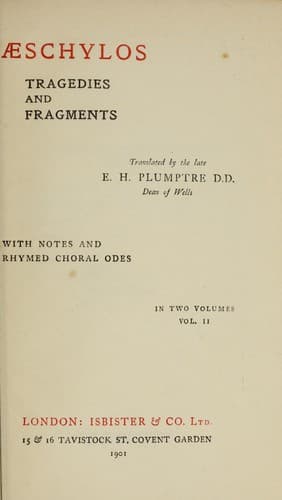
Aeschylus -- Translations into English; Mythology, Greek -- Drama
And now the sword already at the heart,
Sharp-pointed, strikes a blow that pierces through,
While Vengeance guides the hand; 630
For lo! the lawlessness
Of one who doth transgress all lawlessly
The might and majesty of Zeus, lies not
As trampled under foot.[439]
ANTISTROPHE IV
The anvil-block of Vengeance firm is set,
And Fate, the swordsmith, hammers on the bronze
Beforehand; and the child
Is brought unto his home,
And in due time the debt of guilt is paid
By the dark-souled Erinnys, famed of old,
For blood of former days.
ORESTES _and_ PYLADES _enter, disguised as Phokian travellers,
go to the door of the palace, and knock loudly_
_Orest._ What ho, boy! hear us knocking at the gate. 640
Who is within, boy? who, boy?—hear, again;
A third time now I give my summons here,
If good Ægisthos' house be hospitable.
[_A_ SLAVE _opens the door_
_Slave._ Hold, hold; I hear. What stranger comes, and whence?
_Orest._ Tell thou thy lords who over this house rule,
To whom I come and tidings new report;
And make good speed, for now the dusky car
Of night comes on apace, and it is time
For travellers in hospitable homes
To cast their anchor; and let some one come
From out the house who hath authority; 650
The lady, if so be one ruleth here,
But, seemlier far, her lord; for then no shame
In converse makes our words obscure and dim;
But man with man gains courage to speak out,
And makes his mission manifest as day.
_Enter_ CLYTÆMNESTRA
_Clytæm._ If ye need aught, O strangers, speak; for here
Is all that's fitting for a house like ours;
Warm baths,[440] and bed that giveth rest from toil,
And presence of right honest faces too;
If there be aught that needeth counsel more,
That is men's business, and to them we'll tell it. 660
_Orest._ A Daulian traveller, from Phokis come,
Am I, and as I went on business bound,
My baggage with me, unto Argos, I
(Just as I set forth,) met a man I knew not,
Who knew not me, and he then, having asked
My way and told me his, the Phokian Strophios
(For so I learnt in talking) said to me,
“Since thou dost go, my friend, for Argos bound,
In any case, tell those who gave him birth,
Remembering it right well, Orestes' death;
See thou forget it not, and whether plans 670
Prevail to fetch him home, or bury him
There where he is, a stranger evermore,
Bear back the message as thy freight for us;
For now the ribbed sides of an urn of bronze
The ashes hide of one whom men have wept.”
So much I heard and now have told; and if
I speak to kin that have a right in him
I know not, but his father sure should know it.
Public-domain text, read in full here on John Shaqi.
Reviews
Reviews
No reviews yet
Be the first to share your thoughts on this work.
Elsewhere in the archive
Join the Discussion
Join the discussion
Sign in to leave a comment or review.
Sign InorCreate an account