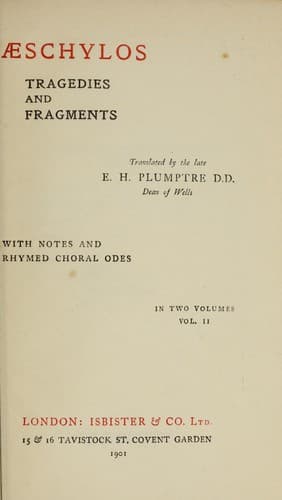
Aeschylus -- Translations into English; Mythology, Greek -- Drama
The Skythian bow, long and elastic, bending either way, like those of
the Arabians (Herod. vii. 69). The connection of Ares with the wild,
fierce tribes of Thrakia and Skythia meets us again and again in the
literature of Greece. He was the only God to whom they built temples
(_ibid._ iv. 59). They sacrificed human victims to an iron sword as
his more appropriate symbol (iv. 62). The use of iron for weapons of
war came to the Greeks from them (_Seven ag. Th._ 729; _Prom._ 714).
Footnote 412:
It may be worth while to compare the method adopted by the three
dramatists of Greece in bringing about the recognition of the brother
by the sister. (1) Here the lock of hair, in its peculiar colour and
texture resembling her own, followed by the likeness of his footsteps
to hers, prepares the way first for vague anticipations, and then the
robe she had made for him, leads to her acceptance of Orestes on his
own discovery of himself. To this it has been objected, by Euripides
in the first instance (_Electra_, vv. 462-500), that the evidence of
the colour of the hair is weak, that a young man's foot must have been
larger than a maiden's, and that he could not have worn as a man the
garment she had made for him as a child. It might be replied, perhaps,
that there are such things as hereditary resemblances extending to the
colour of the hair and the arch of the instep, and that the robe may
either have been shown instead of worn, or, being worn, have been
adapted for the larger growth. (2) In the _Electra_ of Sophocles the
lock of hair alone convinces Chrysothemis that her brother is near at
hand (v. 900), while Electra herself requires the further evidence of
Agamemnon's seal (v. 1223). In Euripides (v. 527), all proof fails
till Orestes shows a scar on his brow, which his sister remembers.
Footnote 413:
The saying is probably one of the widespread proverbs which imply
parables. The idea is obviously that with which we are familiar in the
Gospel “grain of mustard seed.” Here, as in the “kicking against the
pricks” of Acts ix. 5, xxvi. 14, and _Agam._ v. 1604, we are carried
back to a period which lies beyond the range of history as that in
which men took note of the analogies and embodied them in forms like
this.
Footnote 414:
So in the _Odyssey_ (xix. 228), Odysseus appears as wearing a woollen
cloak, on which are embroidered the figures of a fawn and a dog.
Footnote 415:
An obvious reproduction of the words of Andromache (_Il._ vi. 429).
Footnote 416:
The words seem to imply that burning alive was known among the Greeks
as a punishment for the most atrocious crimes. The “oozing pitch,” if
we adopt that rendering, apparently describes something like the
“_tunica molesta_” of Juvenal. (_Sat._ viii. 235.) Hesychios (s. v.
Κωνῆσαι) mentions the practice as alluded to in a lost play of
Æschylos.
Footnote 417:
Public-domain text, read in full here on John Shaqi.
Reviews
Reviews
No reviews yet
Be the first to share your thoughts on this work.
Elsewhere in the archive
Join the Discussion
Join the discussion
Sign in to leave a comment or review.
Sign InorCreate an account