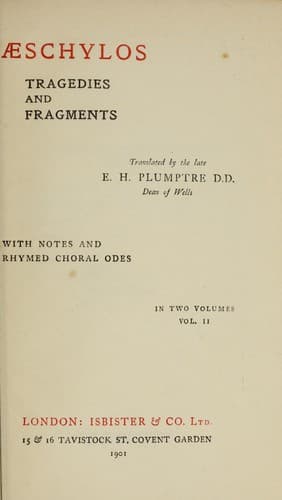
Aeschylus -- Translations into English; Mythology, Greek -- Drama
The words are both doubtful and obscure. Taking the reading which I
have adopted, they seem to mean that while men in general had means of
propitiating the Erinnyes and other Powers for the guilt of unavenged
bloodshed, Orestes and Electra had no such way of escape open to them.
If they, the next of kin, failed to do their work, they would be
exposed to the full storm of wrath. But a conjectural emendation of
one word gives us,
“For making known to men the earth-born ills
That come from wrathful Powers.”
Footnote 418:
Either that old age would come prematurely, or that the hair itself
would share the leprous whiteness of the flesh.
Footnote 419:
The words, as taken in the text, refer to Orestes seeing even in sleep
the spectral forms of the Erinnyes. By some editors the verse is
placed after v. 276, and the lines then read thus:—
“And that he calls fresh onsets of the Erinnyes
As brought to issue from a father's blood,
Seeing clearly, though he move his brow in darkness.”
So taken, the last line refers to Agamemnon, who, though in the
darkness of Hades, sees the penalties which will fail upon his son
should he neglect to take vengeance on his father's murderers.
Footnote 420:
Stress is laid here, as in _Agam._ 1224, on the effeminacy of the
adulterer.
Footnote 421:
The great law of retribution is repeated from _Agam._ 1564. As one of
the earliest utterances of man's moral sense, it was referred
popularly among the Greeks to Rhadamanthos, who with Minos judged the
souls of the dead in Hades. Comp. Aristot. _Ethic. Nicom._, v. 8.
Footnote 422:
The funeral pyre, which consumes the body, leaves the life and power
of the man untouched. The spirit survives, and calls on the Gods that
dwell in darkness to avenge him. The very cry of wailing tends, as a
prayer to them, to the exposure of the murderer.
Footnote 423:
The Lykians, of whom Glaucos and Sarpedon are the representative
heroes in the _Iliad_, are named as the chief allies of the Troïans.
Footnote 424:
The words embody the widespread feeling that the absence of funereal
honours affected the spirit of the dead, and that the souls with whom
he dwelt held him in high or low esteem according as they had been
given or withheld.
Footnote 425:
Pindar (_Pyth._ x. 47), the contemporary of Æschylos, had made the
name of these Hyperborei well known to all Greeks. The vague dreams of
men, before the earth had been searched out, pictured a happy land as
lying beyond their reach. There were Islands of the Blest in the far
West; Æthiopians, peaceful and long-lived, in the South; and far away,
beyond the cold North, a people exempt from the common evils of
humanity. The latter have been connected with the old Aryan belief in
the paradise of Mount Meru. Comp. also Herod. iv. 421; _Prom._ 812.
Footnote 426:
Public-domain text, read in full here on John Shaqi.
Reviews
Reviews
No reviews yet
Be the first to share your thoughts on this work.
Elsewhere in the archive
Join the Discussion
Join the discussion
Sign in to leave a comment or review.
Sign InorCreate an account