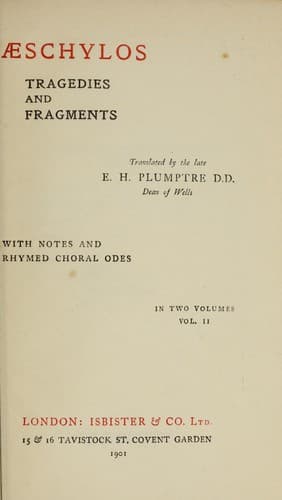
Aeschylus -- Translations into English; Mythology, Greek -- Drama
_Sc._, the beating of both hands upon the breast, as the Chorus
uttered their lamentations.
Footnote 427:
Perhaps, simply “the sharp and bitter cry.” But the rendering in the
text seems justified as repeating the wish already expressed (v. 260),
that the murderers may die by this form of death.
Footnote 428:
The Chorus at this point renew their words and cries of lamentation,
smiting on their breasts. By some critics this speech and Antistrophe
VII. are assigned to Electra, Antistrophe VIII. to the Chorus, with a
corresponding change in the pronouns “my” and “thy.” The Chorus, as
consisting of Troïan captives, is represented as adopting the more
vehement Asiatic forms of wailing. Among these the Arians, Kissians,
and Mariandynians (_Pers._ 920) seem to have been most conspicuous for
their skill in lamentation, and, as such, were in request where hired
mourners were wanted. Compare the opening chorus, v. 22.
Footnote 429:
The practice of mutilating the corpse of a murdered man by cutting off
his hands and feet and fastening them round his waist, seems to have
been looked on as rendering him powerless to seek for vengeance. Comp.
Soph. _Elect._ v. 437. This kind of mutilation, and not mere wanton
outrage, is what the Chorus refer to.
Footnote 430:
As in v. 351 the loss of honour among the dead was represented as one
consequence of the absence of funereal rites from those who loved the
dead, so here the restoration of the children to their rights appears
as the condition without which that dishonour must continue. If they
succeed, then, and then only, can they offer funereal banquets, year
by year, as was the custom. There may be a special reference to an
Argive custom mentioned by Plutarch (_Quæst. Græc._, c. 24) of
sacrificing immediately after the death of a relative to Apollo, and
thirty days later to Hermes.
Footnote 431:
Another reference to the third cup of undiluted wine which men drank
to the honour of Zeus the Preserver. Comp. _Agam._ v. 245.
Footnote 432:
Possibly the pronoun refers to Pylades.
Footnote 433:
Public-domain text, read in full here on John Shaqi.
Reviews
Reviews
No reviews yet
Be the first to share your thoughts on this work.
Elsewhere in the archive
Join the Discussion
Join the discussion
Sign in to leave a comment or review.
Sign InorCreate an account