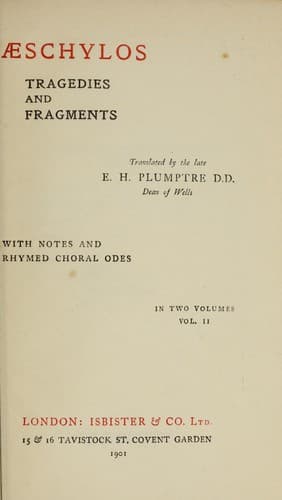
Aeschylus -- Translations into English; Mythology, Greek -- Drama
_Chor._ Rejoice, rejoice once more, ye habitants! 970
I say it yet again,
Ye Gods, and mortals too,
Who dwell in Pallas' city. Should ye treat
With reverence us who dwell
As sojourners among you, ye shall find
No cause to blame your lot.
_Athena._ I praise these words of yours, the prayers ye offer,
And with the light of torches flashing fire,
Will I escort you to your dark abode,[545]
Low down beneath the earth, with my attendants,
Who with due honour guard my statue here,
For now shall issue forth the goodly eye
Of all the land of Theseus; fair-famed troop 980
Of girls and women, band of matrons too,
In upper vestments purple-dyed arrayed:
*Now then advance ye; and the blaze of fire,
Let it go forth, that so this company
Stand forth propitious, henceforth and for aye,
In rearing race of noblest citizens,
_Enter an array of women, young and old, in procession, leading the
Erinnyes—now, as propitiated, the Eumenides or Gentle Ones—to
their shrines_
_Chorus of Athenian women_
STROPHE I
Go to your home, ye great and jealous Ones,
Children of Night, and yet no children ye;[546]
With escort of good-will,
Shout, shout, ye townsmen, shout.
ANTISTROPHE I
There in the dark and gloomy caves of earth,
With worthy gifts and many a sacrifice 990
Consumèd in the fire—
Shout, shout ye, one and all.
STROPHE II
Come, come, with thought benign
Propitious to our land,
Ye dreaded Ones, yea, come,
While on your progress onward ye rejoice,
In the bright light of fire-devourèd torch;
Shout, shout ye to our songs.
ANTISTROPHE II
Let the drink-offerings come,
In order meet behind,
While torches fling their light;
*Zeus the All-seeing thus hath joined in league
*With Destiny for Pallas' citizens;
Shout, shout ye to our songs.
[_The procession winds its way_, ATHENA _at its head, then
the Eumenides, then the women, round the Areopagos
towards the ravine in which the dread Goddesses were
to find their sanctuary._
-----
Footnote 466:
The succession is, in part, accordant with that in the _Theogonia_ of
Hesiod (vv. 116-136), but the special characteristic of the Æschylean
form of the legend is that each change is a step in a due, rightful
succession, as by free gift, not accomplished (as in other narratives
of the same transition) by violence and wrong.
Footnote 467:
Public-domain text, read in full here on John Shaqi.
Reviews
Reviews
No reviews yet
Be the first to share your thoughts on this work.
Elsewhere in the archive
Join the Discussion
Join the discussion
Sign in to leave a comment or review.
Sign InorCreate an account