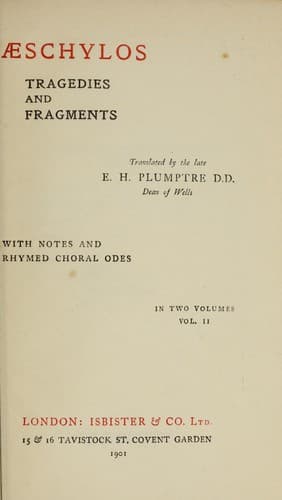
Aeschylus -- Translations into English; Mythology, Greek -- Drama
Phœbe, in the _Theogonia_, marries Coios, and becomes the mother of
Leto, or Latona, and so the grandmother of Apollo. The “birthday gift”
was commonly presented on the eighth day after birth, when the child
was named. The oracle is spoken of as such a gift to Apollo, as
bearing the name of Phœbos.
Footnote 468:
The sacred circular pool of Delos is the crater of an extinct volcano.
There Apollo was born, and thence he passed through Attica to
Parnassos, to take possession of the oracle, according to one form of
the myth, depriving Themis of it and slaying the dragon Python that
kept guard over it.
Footnote 469:
The people of Attica are thus named either as being mythically
descended from Erichthonios the son of Hephæstos, or as artificers,
who own him as their father. The words refer to the supposed origin of
the Sacred Road from Athens to Delphi, passing through Bœotia and
Phokis. When the Athenians sent envoys to consult the oracle they were
preceded by men bearing axes, in remembrance of the original
pioneering work which had been done for Apollo. The first work of
active civilisation was thus connected with the worship of the giver
of Light and Wisdom.
Footnote 470:
Delphos, the hero _Eponymos_ (name-giving) of Delphi, was honoured as
the son of Poseidon. Hence the Priestess invokes the latter as one of
the guardian deities of the shrine.
Footnote 471:
Pronaia, as having her shrine or statue in front of the temple of
Apollo.
Footnote 472:
The Korykian rock in Parnassos, as in Soph., _Antig._, v. 1128; known
also as the “Nymphs' cavern.”
Footnote 473:
Bromios, a name of Dionysos, embodying the special attributes of loud,
half-frenzied revelry.
Footnote 474:
In the legend which Euripides follows, Kithæron, not Parnassos, is the
scene of the death of Pentheus. He, it was said, opposed the wild or
frantic worship of the Pelasgic Bacchos, concealed himself that he
might behold the mysteries of the Mœnads, and was torn to pieces by
his mother and two others, on whose eyes the God had cast such glamour
that they took him for a wild beast. English readers may be referred
to Dean Milman's translation of the _Bacchanals_ of Euripides.
Footnote 475:
Pleistos, topographically, a river flowing through the vale of Delphi,
mythically the father of the nymphs of Korykos.
Footnote 476:
At one time the Oracle had been open to questioners once in the year
only, afterwards once a month. The pilgrims, after they had made their
offerings, cast lots, and the doors were opened to him to whom the lot
had fallen. Plutarch, _Qu. Græc._, p. 292.
Footnote 477:
Public-domain text, read in full here on John Shaqi.
Reviews
Reviews
No reviews yet
Be the first to share your thoughts on this work.
Elsewhere in the archive
Join the Discussion
Join the discussion
Sign in to leave a comment or review.
Sign InorCreate an account