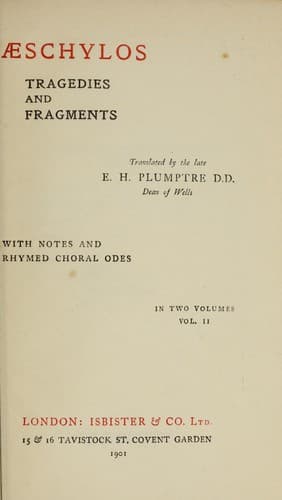
Aeschylus -- Translations into English; Mythology, Greek -- Drama
The altar of the adytum, on the very centre, as men deemed, of the
whole earth. Zeus, it was said, had sent forth two eagles at the same
moment; one from the East and the other from the West, and here it was
that they had met. The stone was of white marble, and the two eagles
were sculptured on it. Strabo, ix. 3.
Footnote 478:
The priestess dwells upon the outward tokens, which showed that the
suppliant came as one whose need was specially urgent. On the ritual
of supplication generally comp. _Suppl._, vv. 22, 348, 641, Soph.,
_Œd. King_, v. 3; _Œd. Col._, vv. 469-489.
Footnote 479:
Æschylos apparently follows the _Theogonia_ of Hesiod, (l. 278), who
describes the Gorgons as three in number, daughters of Phorkys and
Keto, and bearing the names of Stheno, Euryale, and Medusa. The last
enters into the Perseus cycle of myths, as one of the monsters whom he
conquered, with a face once beautiful, but with her hair turned to
serpents by the wrath of Athena, and so dreadful to look upon that
those who gazed on her were turned to stone. When Perseus had slain
her, Athena placed her head in her ægis, and thus became the terror of
all who were foes to herself or her people. A wild legendary account
of them meets us in the _Prom. Bound_, v. 812. As works of art, the
Gorgon images are traceable to the earliest or Kyclopian period.
Footnote 480:
Here also we have a reference to a familiar subject of early Greek
art, probably to some painting familiar to an Athenian audience. The
name of Phineus indicates that the monstrous forms spoken of are those
of the Harpies, birds with women's faces, or women with birds' wings,
who were sent to vex the blind seer for his cruelty to the children of
his first marriage. Comp. Soph. _Antig._, v. 973. In the _Æneid_ they
appear (iii. 225) as dwelling in the Strophades, and harassing Æneas
and his companions.
Footnote 481:
The old image of Pallas, carved in olive-wood, as distinguished from
later sculpture.
Footnote 482:
The early code of hospitality bound the host, who as such had once
received a guest under the shelter of his roof, not to desert him,
even though he might discover afterwards that he had been guilty of
great crimes, but to escort him safely to the boundary of his
territory. Thus Apollo, as the host with whom Orestes had taken
refuge, sends Hermes, the escort God, to guide and defend him on his
way to Athens.
Footnote 483:
The thought that the highest wisdom came to men rather in “visions of
the night, when deep sleep falleth on men,” than through the waking
senses, which we have already met with in _Agam._, v. 173, is
traceable to the mysticism of Pythagoras, more distinctly perhaps to
that of Epimenides.
Footnote 484:
Public-domain text, read in full here on John Shaqi.
Reviews
Reviews
No reviews yet
Be the first to share your thoughts on this work.
Elsewhere in the archive
Join the Discussion
Join the discussion
Sign in to leave a comment or review.
Sign InorCreate an account