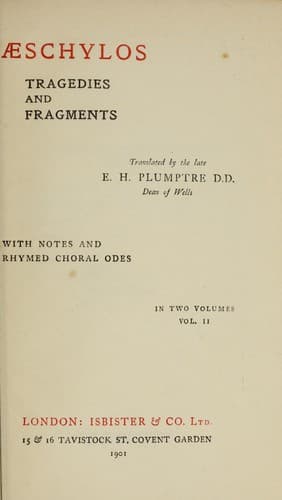
Aeschylus -- Translations into English; Mythology, Greek -- Drama
Wine, as in Soph. _Œd. Col._, vv. 100, 481, was rigidly excluded from
the _cultus_ of the Eumenides, and to them only as daughters of Night
were midnight sacrifices offered. We must not lose sight of the
thought thus implied, that Clytæmnestra had herself lived, after her
deed of guilt, in perpetual terror of the Erinnyes, seeking to soothe
them by her sacrifices.
Footnote 485:
The common rendering “in a dream” gives a sufficient meaning, and is,
of course, tenable enough. But there is a force in the repetition of
the same word, as in v. 116, which is thus lost, and which I have
endeavoured to preserve. The Erinnyes, thus impotent in their rage,
are as much mere dreamlike spectres as is the ghost of Clytæmnestra.
Footnote 486:
Here, as throughout Æschylos, the Olympian divinities are thought of
as new comers, thrusting from their thrones the whole Chthonian and
Titanic dynasty, Gods of the conquering Hellenes superseding those of
the Pelasgi.
Footnote 487:
The accumulation of horrid forms of cruelty had, probably, a special
significance for the Athenians. These punishments belonged to their
enemies, the Persians, not to the Hellenic race, and the poet's
purpose was to rekindle patriotic feeling by dwelling on their
barbarity, as in _Agam._, v. 894, he points in like manner to their
haughtiness and luxury.
Footnote 488:
The argument of the Erinnyes is, to some extent, like that of the
Antigone of Sophocles (_Antig._, 909-913), and the wife of Intaphernes
(Herod. iii. 119). The tie which binds the husband to the wife is less
sacred than that between the mother and the son. This, therefore,
brings on the slayer the guilt of blood of kin, while murder in the
other case is reduced to simple homicide. Orestes therefore was not
justified in perpetrating the greater crime as a retribution for the
less. Apollo, in meeting this plea, asserts the sacredness of the
marriage bond as standing on the same level as that of consanguinity.
Footnote 489:
The ideal interval of time between the two parts of the drama is left
undefined, but it would seem from vv. 230, 274-6, and 429, to have
been long enough to have allowed of many wanderings to sacred places,
Orestes does not go straight from Delphi to Athens. He appears now,
not as before dripping and besmeared with blood, but with hands and
garments purified.
Footnote 490:
The story of Adrastos and Crœsos in Herod. i. 35, illustrates the
gradual purification of which Orestes speaks. The penitent who has the
stain of blood-guiltiness upon him comes to the king, and the king, as
his host, performs the lustral rites for him. Here Orestes urges that
he has been received at many homes, and gone through many such
lustrations. He has been cleansed from the pollution of sin: what he
now seeks, to use the terminology of a later system, is a forensic
justification.
Footnote 491:
Public-domain text, read in full here on John Shaqi.
Reviews
Reviews
No reviews yet
Be the first to share your thoughts on this work.
Elsewhere in the archive
Join the Discussion
Join the discussion
Sign in to leave a comment or review.
Sign InorCreate an account