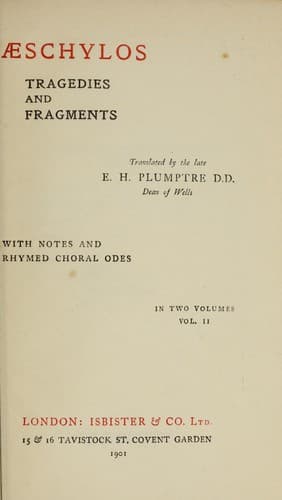
Aeschylus -- Translations into English; Mythology, Greek -- Drama
_Sc._, the scent of blood, which, though no longer visible to the eyes
of men, still lingers round him and is perceptible to his pursuers.
Footnote 492:
Here, too, we trace the political bearing of the play. In the year
when it was produced (B.C. 458) an alliance with Argos was the
favourite measure of the more conservative party at Athens.
Footnote 493:
The names Triton and Tritonis, wherever found in classical geography
(Libya, Crete, Thessaly, Bœotia), are always connected with the legend
that Athena was born there. Probably both name and legend were carried
from Greece to Libya, and then amalgamated with the indigenous local
worship of a warlike goddess. Hesiod (iv. 180, 188) connects the
Libyan lake with the legend of Jason and Argonauts.
Footnote 494:
In the war with the giants fought in the Phlegræan plains (the
volcanic district of Campania) Athena had helped her father Zeus by
her wise counsel, and was honoured there as keeping in check the
destructive Titanic forces which had been so subdued, burying
Enkelados, _e.g._, in Sicily. The “friends” are her Libyan
worshippers. The passage is interesting, as showing the extent of
Æschylos's acquaintance with the African and Italian coasts of the
Mediterranean.
Footnote 495:
The Choral ode here is brought in as an incantation. This weapon is to
succeed where others have failed, and this too, the frenzy which
seizes the soul in the remembrance of its past transgression, is
soothed and banished by Athena.
Footnote 496:
White, as the special colour of festal joy, was not used in the
worship of the Erinnyes.
Footnote 497:
Another rendering gives—
“To dim the bright hue of the fresh-shed blood.”
Footnote 498:
The thought which underlies the obscurity of a corrupt passage seems
to be that, as they relieve the Gods from the task of being avengers
of blood, all that the Gods on their side can legitimately do against
them is to render powerless the prayers for vengeance offered by the
kindred of the slain. Their very isolation, as Chthonian deities, from
the Gods of Olympos should protect them from open conflict. But an
alternative rendering of the second line gives, perhaps, a better
meaning—
“And by the prayers men offer unto me
Work freedom for the Gods;”
_i.e._, by being the appointed receivers of such prayers for
vengeance, they leave the Gods free for a higher and serener life.
Footnote 499:
Perhaps, “With torch of sunless gloom.”
Footnote 500:
Public-domain text, read in full here on John Shaqi.
Reviews
Reviews
No reviews yet
Be the first to share your thoughts on this work.
Elsewhere in the archive
Join the Discussion
Join the discussion
Sign in to leave a comment or review.
Sign InorCreate an account