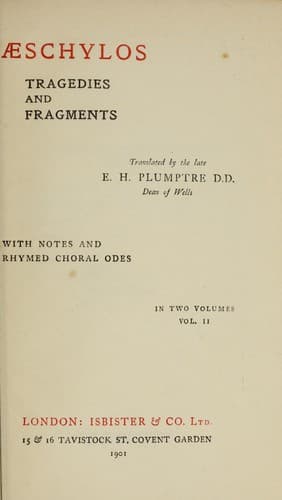
Aeschylus -- Translations into English; Mythology, Greek -- Drama
In heathen, as in Jewish sacrifices, the blood was the very instrument
of purification. It was sprinkled or poured upon men, and they became
clean. But this could not be done by the criminal himself, nor by any
chance person. The service had to be rendered by a friend, who of very
love gave himself to this mediatorial work.
Footnote 506:
In the legend related by Pausanias (_Corinth._, c. 3), Trœzen was the
first place where Orestes was thus received, and in his time the
descendants of those who had thus helped held periodical feasts in
commemoration of it.
Footnote 507:
The course which Athena takes is: (1) to receive Orestes as a settler
with the rights which attached to such persons on Athenian soil, not a
criminal fugitive to be simply surrendered; (2) to offer to the
Erinnyes, as being too important to be put out of court, a fair and
open trial; (3) to acknowledge that he and they are equally
“blameless,” as far as she is concerned. She has no complaint to make
of them.
Footnote 508:
The red blight of vines and wheat was looked on as caused by drops of
blood which the Erinnyes had let fall.
Footnote 509:
Stress is laid on the fact that the judges of the Areopagos, in
contrast with those of the inferior tribunes of Athens, discharged
their duty under the sanction of an oath.
Footnote 510:
Perhaps
“And each from each shall learn, as he predicts
His neighbour's ills, that he
Shares in the same and harbours them, and speaks,
Poor wretch, of cures that fail.”
Footnote 511:
At a more advanced period of human thought, Cicero (_Orat. pro
Roscio_, c. 24) could point to the “thoughts that accuse each other,”
the horror and remorse of the criminal, as the true Erinnyes, the
“assiduæ domesticæque Furiæ.” Æschylos clings to the mythical
symbolism as indispensable for the preservation of the truth which it
shadowed forth.
Footnote 512:
Once again we have the poet of constitutional conservatism keeping the
_via media_ between Peisistratos and Pericles.
Footnote 513:
The Tyrrhenian trumpet, with its bent and twisted tube, retained its
proverbial pre-eminence from the days of Æschylos and Sophocles
(_Aias_, 17) to those of Virgil (_Æn._, viii. 526).
Footnote 514:
The fondness of the Athenians for litigation, and the large share
which every citizen took in the administration of justice, would
probably make the scene which follows, with all its technicalities,
the part of the play into which they would most enter.
Footnote 515:
It was necessary that some one, sitting as President of the Court,
should formally open the pleadings, by calling on this side or that to
begin. Here Athena takes that office on herself, and calls on the
Erinnyes.
Footnote 516:
Public-domain text, read in full here on John Shaqi.
Reviews
Reviews
No reviews yet
Be the first to share your thoughts on this work.
Elsewhere in the archive
Join the Discussion
Join the discussion
Sign in to leave a comment or review.
Sign InorCreate an account