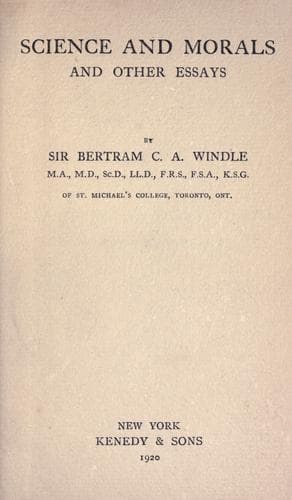
Science and Morals and Other EssaysWindle, Bertram Coghill Alan, Sir
Religion
Science and Morals and Other Essays
Windle, Bertram Coghill Alan, Sir
Essays; Religion and science; Science
As to the Christian ideals little need be said, since we know very well
what they are, and know this most especially, that practically all of
them are in direct opposition to what we may call the ideals of Nature,
and exercise all their influence in frustrating such laws as that of
Natural Selection. "Nature's Insurgent Son," as Sir Ray Lankester calls
him,[14] is at constant war with Nature, and when we come to consider
the matter carefully, in that respect most fully differentiates himself
from all other living things, none of which make any attempt to control
the forces of Nature for their own advantage. "Nature's inexorable
discipline of death to those who do not rise to her standard--survival
and parentage for those alone who do--has been from the earliest times
more and more definitely resisted by the will of man. If we may for the
purpose of analysis, as it were, extract man from the rest of Nature, of
which he is truly a product and a part, then we may say that man is
Nature's rebel. Where Nature says 'Die!' man says 'I will live.'"[15]
To this it may be added that, under the influence of Christianity, man
goes a step further and says: "I will endeavour that as many others as
may be shall live, and live happy, healthy lives, and shall not untimely
die." The law of Natural Selection could not be met by more direct
opposition. I have said that this is under the influence of
Christianity, yet the impulse seems to be older than that, to be part of
that moral law which excited Kant's admiration, which he coupled with
the sight of the starry heavens, an impulse, we can scarcely doubt,
implanted in the heart of man by God Himself. It is a remarkable fact
that in many--some would say most--of the less civilised races of
mankind we find these social virtues, which some would have us believe
are degenerate features foisted on to the race by an enervating
superstition.
Dr. Marett has carefully examined into this matter, and his conclusions
are of the greatest interest.[16]
Public-domain text, read in full here on John Shaqi.
Reviews
Reviews
No reviews yet
Be the first to share your thoughts on this work.
Join the Discussion
Join the discussion
Sign in to leave a comment or review.
Sign InorCreate an account