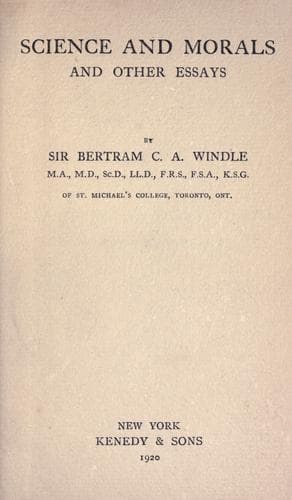
Science and Morals and Other EssaysWindle, Bertram Coghill Alan, Sir
Religion
Science and Morals and Other Essays
Windle, Bertram Coghill Alan, Sir
Essays; Religion and science; Science
"My own theory about the peasant, as I know him, and about
people of lowly culture in general so far as I have learnt
to know about them, is that the ethics of amity belong to
their natural and normal mood, whereas the ethics of enmity,
being but 'as the shadow of a passing fear,' are relatively
accidental. Thus to the thesis that human charity is a
by-product, I retort squarely with the counter-thesis that
human hatred is a by-product. The brute that lurks in our
common human nature will break bounds sometimes; but I
believe that whenever man, be he savage or civilised, is at
home to himself, his pleasure and pride is to play the good
neighbour. It may be urged by way of objection that I
overestimate the amenities, whether economic or ethical, of
the primitive state; that a hard life is bound to produce a
hard man. I am afraid that the psychological necessity of
the alleged correlation is by no means evident to me. Surely
the hard-working individual can find plenty of scope for his
energies without needing, let us say, to beat his wife. Nor
are the hard-working peoples of the earth especially
notorious for their inhumanity. Thus the Eskimo, whose life
is one long fight against the cold, has the warmest of
hearts. Mr. Stefanson says of his newly discovered 'Blonde
Eskimo,' a people still living in the stone age: 'They are
the equals of the best of our own race in good breeding,
kindness, and the substantial virtues.'[17] Or again, heat
instead of cold may drive man to the utmost limit of his
natural affections. In the deserts of Central Australia,
where the native is ever threatened by a scarcity of food,
his constant preoccupation is not how to prey on his
companions. Rather he unites with them in guilds and
brotherhoods, so that they may feast together in the spirit,
sustaining themselves with the common hope and mutual
suggestion of better luck to come. But there is no need to
go so far afield for one's proofs. I appeal to those who
have made it their business to be intimate with the folk of
our own countryside. Is it not the fact that unselfishness
in regard to the sharing of the necessaries of life is
characteristic of those who find them most difficult to come
by? The poor are by no means the least 'rich towards God.'
At any rate, if poverty sometimes hardens, wealth,
especially sudden wealth, can harden too, causing arrogance,
boastfulness, and the bullying temper. 'A proud look, a
lying tongue, and the shedding of innocent blood'--these go
together."
Public-domain text, read in full here on John Shaqi.
Reviews
Reviews
No reviews yet
Be the first to share your thoughts on this work.
Join the Discussion
Join the discussion
Sign in to leave a comment or review.
Sign InorCreate an account