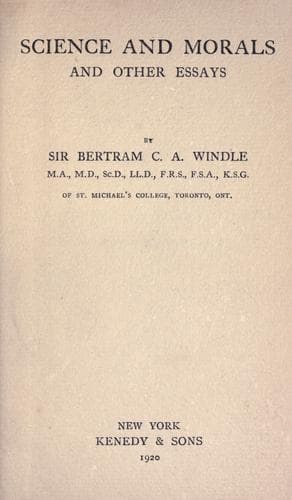
Science and Morals and Other EssaysWindle, Bertram Coghill Alan, Sir
Religion
Science and Morals and Other Essays
Windle, Bertram Coghill Alan, Sir
Essays; Religion and science; Science
In the first place such a doctrine leads directly to the conclusion that
war, instead of being the curse and disaster which all reasonable
people, not to say all Christians, feel it to be, is, as Bernhardi puts
it, "a biological necessity, a regulative element in the life of mankind
that cannot be dispensed with." It is "the basis of all healthy
development." "Struggle is not merely the destructive but the
life-giving principle. The law of the strong holds good everywhere.
Those forms survive which are able to secure for themselves the most
favourable conditions. The weaker succumb." Humanity has had at times
evidences of the results of this teaching which are not, one may fairly
say, of a kind to commend themselves to any person possessed of a
moderately kindly, not to say of a Christian, disposition. Fortunately,
or unfortunately, we have the opportunity of studying the experiment in
actual operation in a race which, of course in entire ignorance of the
fact, is actually putting into practice the teachings of Natural
Selection, though it must be admitted that the practice has not been
successful, nor does it look like being successful, in raising that race
above the very lowest rung of the ladder of civilisation. Captain
Whiffen[19] has given a very complete and a very interesting account of
the peoples whom he met with during his wanderings in the regions
indicated by the title of his book. And he tells us that "the survival
of the most fit is the very real and the very stern rule of life in the
Amazonian forests. From birth to death it rules the Indians' life and
philosophy. To help to preserve the unfit would often be to prejudice
the chances of the fit. There are no arm-chair sentimentalists to oppose
this very practical consideration. The Indian judges it by his standard
of common sense: why live a life that has ceased to be worth living when
there is no bugbear of a hell to make one cling to the most miserable of
existences rather than risk greater misery?" Let us now see the kind of
life which the author, freed himself no doubt from "the bugbear of
hell," considers eminently sensible--the kind of life of which only an
"arm-chair sentimentalist" would disapprove; a kind of life, it may be
added, which will appear to most ordinarily minded people as being one
of selfishness raised to its highest power.
Public-domain text, read in full here on John Shaqi.
Reviews
Reviews
No reviews yet
Be the first to share your thoughts on this work.
Join the Discussion
Join the discussion
Sign in to leave a comment or review.
Sign InorCreate an account