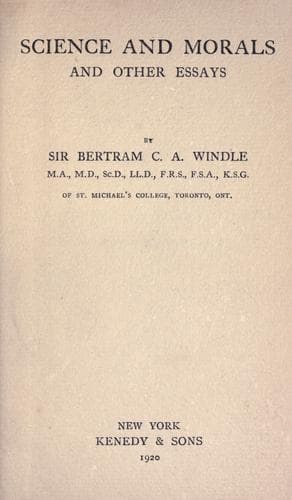
Science and Morals and Other EssaysWindle, Bertram Coghill Alan, Sir
Religion
Science and Morals and Other Essays
Windle, Bertram Coghill Alan, Sir
Essays; Religion and science; Science
To begin with the earliest event in life. If a child, on its appearance
in the world, appears to be in any way defective, its mother quietly
kills it and deposits its body in the forest. If the mother dies in
childbirth the child, unless someone takes pity on it and adopts it, is
killed by the father, who, it may be presumed, is indisposed to take the
trouble, perhaps indeed incapable of doing so, of rearing the motherless
babe. That the child, in any case, immediately after birth, is plunged
into cold water, is not perhaps a conscious method of eliminating the
weak, though it must operate in that direction. At a later period of
life should any disease believed to be infectious break out in a tribe,
"those attacked by it are immediately left, even by their closest
relatives, the house is abandoned, and possibly even burnt. Such
derelict houses are no uncommon sight in the forest, grimly desolate
mementoes of possible tragedies." When a person becomes insane, he is
first of all exorcised by the medicine man, and if that fails is put to
death by poison by the same functionary. The sick are dealt with on
similar lines, unless there is or seems to be a probability of speedy
recovery. "Cases of chronic illness meet with no sympathy from the
Indians. A man who cannot hunt or fight is regarded as useless, he is
merely a burden on the community." Under these circumstances he is
either left at home untended or hunted out into the bush to die, or his
end is accelerated by the medicine man. The same fate awaits the aged,
unless they seem to be of value to the tribe on account of their wisdom
and experience.
All these things placed together give us a perfect picture of life under
Natural Selection, and having studied it we may fairly ask whether such
a rule of life is one under which any one of us would like to live. In
every respect it is the antipodes of the Christian rule of life, and of
that rule of life which civilised countries, whether in fact Christian
or not, have derived from Christianity and still practise. The
non-Christian rule of the Indians is one under which might is right and
no real individual liberty exists, all personal rights being sacrificed
to the supposed needs and benefit of the community.
So much from the point of view of Natural Selection, but it would appear
that those who have given up that factor as of anything but a very minor
value, if even that, have also their rule of life founded on their
interpretation of Nature. Thus Professor Bateson, the great exponent of
Mendel's doctrines, who has told us in his Presidential Address to the
British Association that we must think much less highly of Natural
Selection than some would have us do, has, as has been set forth in the
previous section of this essay, his opinion as to the rule of life which
we should follow.
Public-domain text, read in full here on John Shaqi.
Reviews
Reviews
No reviews yet
Be the first to share your thoughts on this work.
Join the Discussion
Join the discussion
Sign in to leave a comment or review.
Sign InorCreate an account